
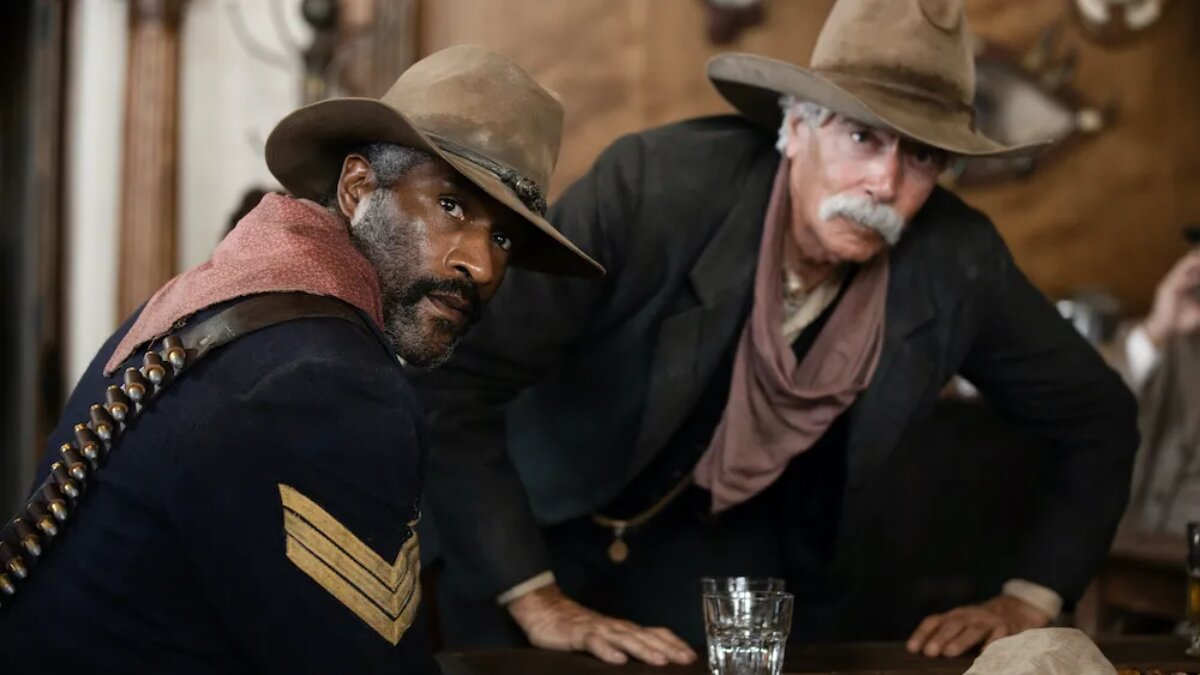
“1883” has been widely acclaimed for its dedication to historical accuracy, yet a notable anomaly—character’s conspicuously perfect teeth—stands out against this backdrop. Nevertheless, this minor deviation doesn’t significantly affect the show’s narrative, which remains its primary focus. Creator Taylor Sheridan meticulously ensured historical precision by enlisting a team of historians to contribute to the authenticity of the period depicted. The series’ success in accurately portraying the socioeconomic conditions of that era, supported by meticulous attention to detail in set design, is a testament to Sheridan’s commitment to authenticity, a quality evident in his prior work, notably the neo-western crime film “Wind River.”
Despite this break in historical continuity, less severe than infamous errors like the Jeans Guy in “The Mandalorian” or the Starbucks Cup in “Game of Thrones,” some fans have criticized the show online, pointing out this apparent inconsistency. However, the setting, characters’ motivations, and the essence of the period remain the primary focal points for Sheridan. Honoring the stories of those who lived during that time supersedes perfectionism. While “1883” may not achieve absolute historical accuracy, it manages to offer a reasonably faithful representation of the period.
The spin-off, “1883,” chronicles the pre-Civil War journey of the Dutton family across the American West to establish what eventually becomes the Yellowstone Ranch. Taylor Sheridan, building on the success of “Yellowstone,” aimed to tell the true story of the American West, emphasizing the inaccurate portrayals of pioneers in past Western stories. He highlighted the diverse origins of pioneers and their challenges, demonstrated in scenes where Shea Brennan (played by Sam Elliott) assists immigrant settlers, facing language and cultural barriers on their journey.
Executive Producer David Glasser emphasized Sheridan’s commitment to authenticity, ensuring that sets, props, and costumes were meticulously constructed to match the period. However, the discrepancy in characters’ dental perfection amid historical accuracy has raised questions among fans.
The show’s flaw lies in the portrayal of uniformly pristine teeth, contrasting starkly with the harsh reality of frontier dentistry. The absence of quality dental care during that time led to prevalent dental issues, with extraction being the primary solution. The scarcity of anesthetics meant that procedures were often painful, leaving many with missing or damaged teeth—a reality absent from the show’s depiction.
Despite this oversight, the debate centers on whether such details disrupt the audience’s immersion. In comparison, series like “Deadwood,” which depicted characters with visibly poor dental health, are remembered more for their storyline intricacies and character developments rather than historical dental accuracy.
Sheridan’s goal wasn’t to create a documentary but to craft compelling stories rooted in the essence of the American West. The focus remains on the drama, relationships, and struggles of the characters, capturing the humanity and challenges of the time. The characters’ performances and the immersive setting serve the narrative’s essence, rendering minute historical inaccuracies negligible in the grander scheme of storytelling.
Sheridan’s expansive universe, encompassing “Yellowstone” and its spin-offs, resonates with audiences due to its blend of truth and drama. While acknowledging historical inconsistencies, viewers are drawn into a richly detailed world that captures the essence of the American West. Ultimately, despite playful scrutiny over the flaw of pristine teeth, Sheridan’s storytelling prowess triumphs, offering audiences an immersive and compelling narrative, forgiving minor imperfections for the sake of a captivating story.
