

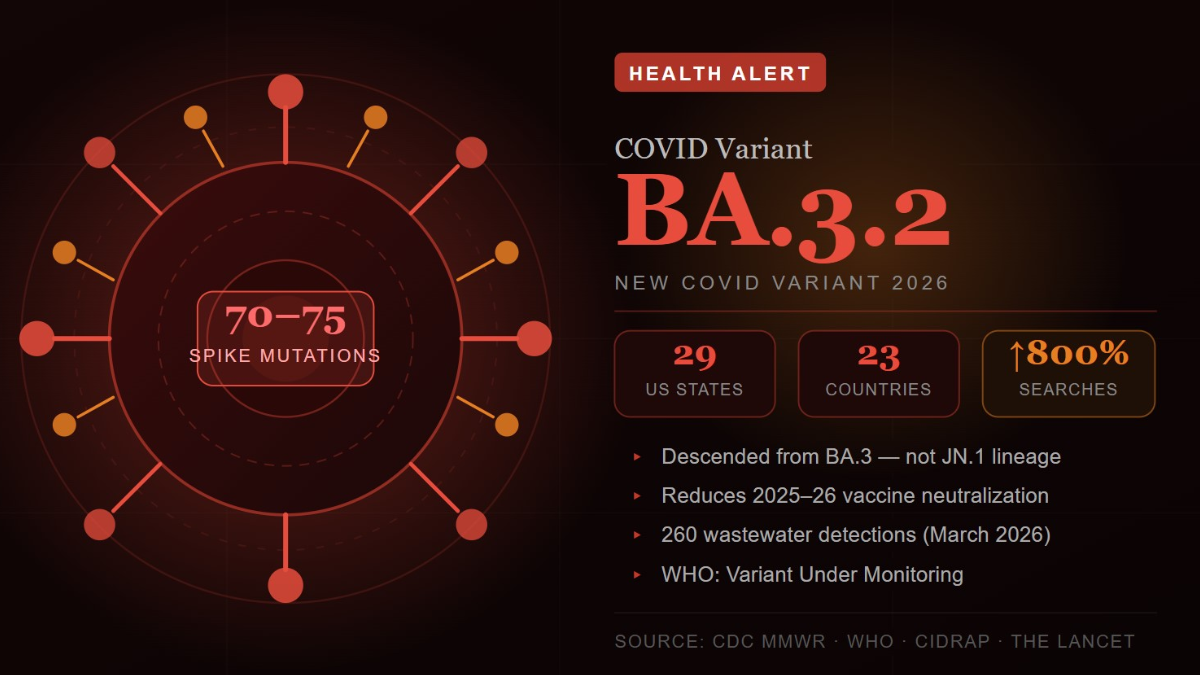
The highly mutated COVID variant BA.3.2 has been found in wastewater samples across 25 U.S. states and among travelers and clinical patients, leading the Centers for Disease Control and Prevention (CDC) to ramp up its genomic surveillance activities. BA.3.2, a descendant of Omicron (first identified in South Africa in Nov. 2024), started spreading through South Africa in Sept. 2025, and it is now in at least 23 countries, including the U.S. The first identified case in the U.S. was of a traveler from the Netherlands who arrived at San Francisco International Airport in June 2025, after which BA.3.2 was found in four U.S. travelers’ nasal swabs, clinically-confirmed cases, airplane wastewater, and 132 wastewater samples nationwide.
BA.3.2 has a high number (approximately 70-75) of substitutions and deletions in its spike protein when compared to those in the JN.1 and LP.8.1 lineages targeted by the current (2025-2026) COVID vaccines. Laboratory studies also suggest BA.3.2 possesses strong immune escape potential; thus, the updated mRNA vaccine tested had the least amount of neutralization against BA.3.2 when compared to all other variants tested. U.S. experts caution that these genetic differences may permit the spread of BA.3.2 more easily and lead to decreased immunity from previous disease recovery or vaccinations.
Currently, there is no evidence of increased transmissibility or severity of the BA.3.2 variant relative to other recently circulating variants, and overall COVID activity in the U.S. remains stable, without a significant surge associated with BA.3.2. Nevertheless, ongoing monitoring will be necessary since further changes to BD variability may occur.
Health officials emphasize that, while the BA.3.2 variant may reduce some immunity, an individual’s degree of immunity against severity or hospitalization due to his/her vaccination status and receiving antiviral treatment, so there are significant benefits to the current vaccines and antivirals.
According to the CDC, the robust surveillance conducted during the emergence of the BA.3.2 variant will be used to determine how/when to provide updates to vaccines if necessary. The evolution of SARS-CoV-2 continues, which emphasizes the importance of preparing for the possibility that a new variant will emerge.