
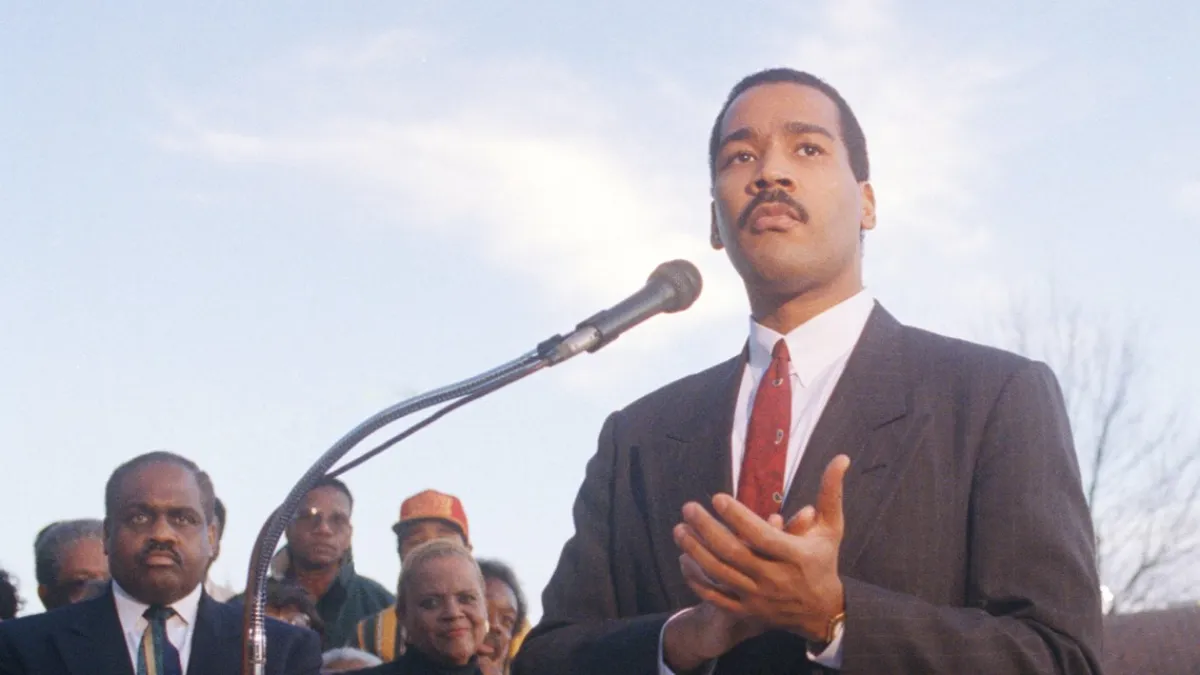
On January 22, 2024, the world lost a stalwart guardian of civil rights and a torchbearer of the legacy of the Rev. Martin Luther King Jr. Dexter Scott King, the third child of Martin Luther King Jr. and Coretta Scott King, passed away peacefully in his sleep at his home in Malibu, California, at the age of 62. Dexter’s life was characterized by an unwavering commitment to social justice, equality, and the preservation of his parents’ monumental contributions to the Civil Rights Movement.
Named after the Dexter Avenue Baptist Church in Montgomery, Alabama, where his father served as a pastor during the historic Montgomery bus boycott, Dexter Scott King was immersed in the struggle for civil rights from a young age. The impact of his father’s assassination when he was just seven years old profoundly shaped Dexter’s perspective and set him on a path of activism.
As an adult, Dexter assumed a pivotal role in preserving and advancing the civil rights legacy. Serving as the chairman of the King Center in Atlanta, he worked tirelessly to ensure that his parents’ principles of nonviolence and equality continued to inspire and guide future generations.
Dexter Scott King was not only a guardian of his family’s legacy but also faced personal challenges and struggles. In his 2004 memoir, “Growing Up King,” he candidly shared the difficulties he experienced in maintaining a formal and serious demeanor, burdened by the tragic events that marked his childhood.
In the public eye, Dexter bore a striking resemblance to his famous father, leading him to portray Martin Luther King Jr. in a 2002 TV movie about Rosa Parks, a pivotal figure in the Civil Rights Movement.
Beyond his role as chairman of the King Center, Dexter Scott King played a crucial role in protecting the King family’s intellectual property. As president of the King estate, he worked to ensure that his father’s speeches, writings, and image were used with respect and integrity.
Dexter’s advocacy extended to the controversial case of James Earl Ray, the man who pleaded guilty to the murder of Martin Luther King Jr. in 1969. In 1997, Dexter publicly declared his belief in Ray’s innocence, expressing a desire for a trial to explore the possibility of a broader conspiracy. Despite Ray’s death from liver failure the following year, Dexter’s pursuit of justice was indicative of his dedication to truth and accountability.
Dexter Scott King’s passing leaves a void in the civil rights community, but his legacy endures through his family. He is survived by his wife, Leah Weber King, his older brother Martin Luther King III, his younger sister Rev. Bernice A. King, and his teenage niece, Yolanda Renee King. The Kings, through triumphs and tribulations, remain a symbol of resilience and commitment to the ideals that defined the Civil Rights Movement.
As we reflect on Dexter Scott King’s life, we recognize his immeasurable contributions to the ongoing fight for justice and equality. His dedication to preserving the legacy of Martin Luther King Jr. serves as an enduring inspiration for all those who continue to strive for a world built on the principles of compassion, understanding, and social justice.
