

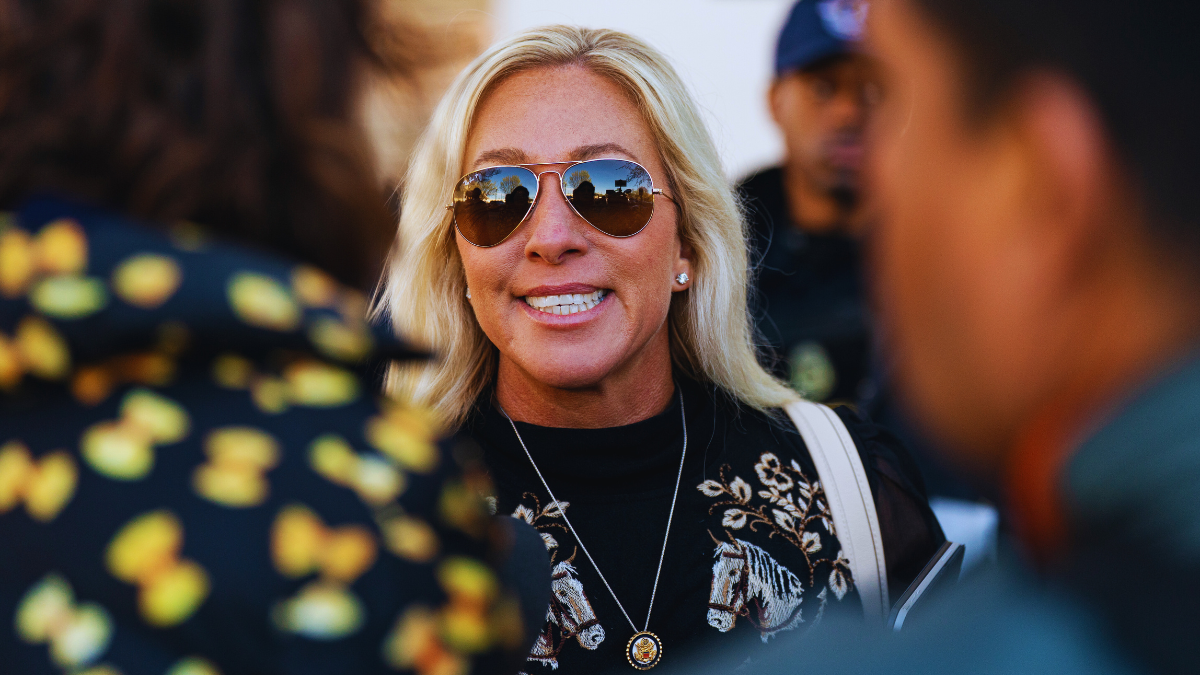
Marjorie Taylor Greene’s transformation from MAGA loyalist to internal adversary is accelerating, and the fallout is getting personal. A new report reveals that White House officials recently contacted the Secret Service over concerns involving Greene and the left-wing protest group Code Pink, marking a stunning turn in her relationship with Donald Trump’s inner circle.
White House suspicion after disrupted Trump dinner
The controversy centers on an unplanned dinner President Trump held with aides at a Washington, D.C. restaurant, a visit meant to underscore claims that crime in the capital is declining. The evening took an unexpected turn when Code Pink protesters appeared, loudly confronting Trump and recording the encounter.
According to administration officials, suspicion quickly focused on Greene. Staffers reportedly questioned whether she may have alerted protesters to the dinner’s location after learning she had repeatedly encouraged Trump to visit the restaurant and was expected to attend herself, only to abruptly not show up.
The timing raised eyebrows. Almost immediately after the protest, Greene intensified her public criticism of Trump, deepening internal doubts about her intentions.
The alleged incident comes amid a broader collapse in the once-symbiotic relationship between Greene and Trump. The former congresswoman has increasingly distanced herself from the administration, citing disagreements over power, loyalty, and Trump’s handling of documents related to Jeffrey Epstein.
Greene has framed her shift as principled independence, declaring she will no longer follow party directives when they conflict with her personal beliefs. Trump allies, however, see it differently, interpreting her behavior as retaliation after being sidelined politically.
Trump has reportedly dismissed Greene as politically toxic, while Greene has accused the president of retaliatory behavior aimed at silencing critics within his own movement.
Marjorie Taylor Greene pushes back hard
Greene has categorically denied any coordination with Code Pink, calling the allegations reckless and dangerous. She has argued that linking her to an organization ideologically opposed to nearly everything she supports is both illogical and defamatory.
Code Pink itself dismissed the claims outright, publicly stating there is no collaboration and emphasizing that Greene’s political views are fundamentally incompatible with their mission. The group advocates for progressive social policies, including reproductive rights, universal healthcare, and housing protections, positions Greene has consistently opposed.
MAGA loyalty no longer guaranteed
What makes this episode especially striking is how quickly Greene has gone from insider to suspect. Only months ago, she was one of Trump’s most vocal defenders, routinely attacking media outlets and dismissing criticism of his past associations.
Now, Greene openly references reporting from those same outlets to support her critique of Trump’s handling of the Epstein issue, a reversal that has not gone unnoticed by MAGA loyalists.
Political observers say this ideological whiplash has made her untrustworthy in the eyes of Trump’s camp, which places loyalty above all else.
Despite Greene’s insistence that her convictions remain unchanged, insiders suggest her return to Trump’s inner circle is effectively impossible. Trump has publicly derided her ideas and questioned her value to the movement, while Greene has hinted at stepping away from politics altogether.
Still, few believe this feud is truly over. Both figures thrive on public conflict, and their overlapping audiences ensure future clashes will attract attention.
What began as a political alliance built on outrage and loyalty has devolved into mutual suspicion, a vivid example of how quickly MAGA power dynamics can turn inward.