

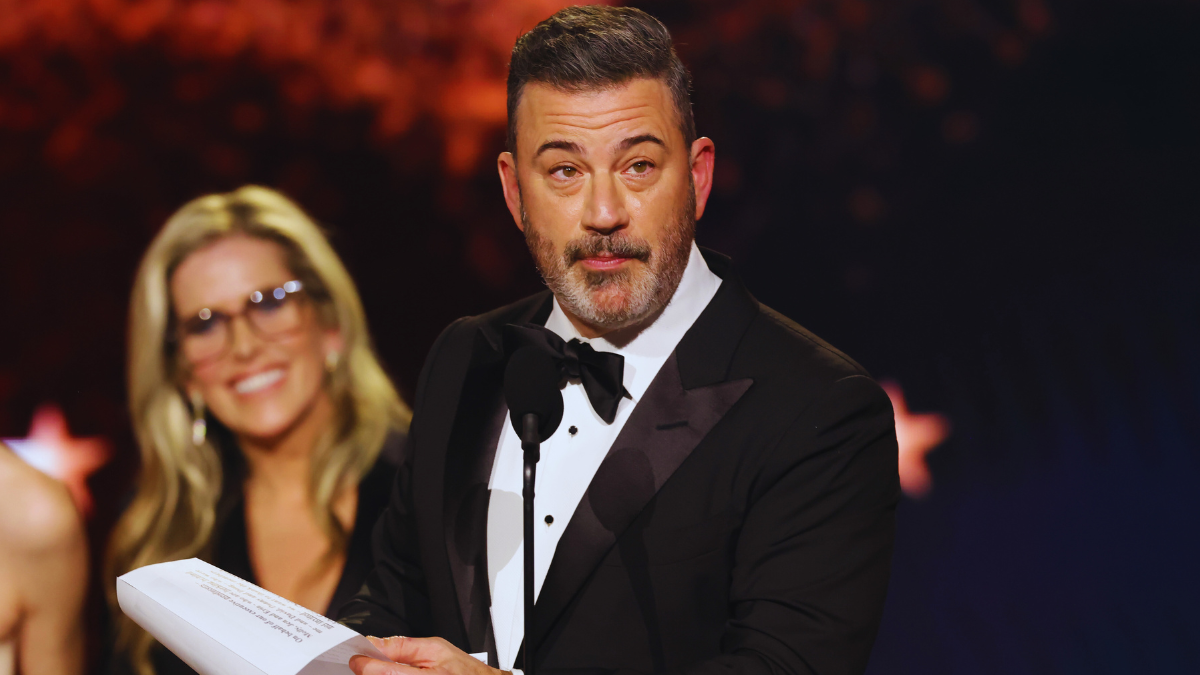
Fresh off a major win at the Critics’ Choice Awards, Jimmy Kimmel returned to late-night television with a monologue that cut through the national grief and outrage surrounding the ICE shooting in Minneapolis. Rather than offering light escapism, Kimmel leaned into the moment, using humor to dissect what he portrayed as a dangerous erosion of truth in American politics.
The comedian’s focus was clear: the federal response to the killing of Renee Nicole Good, and what he described as a coordinated effort by the Trump administration to reshape public perception despite video evidence.
Jimmy Kimmel responds to Renee Nicole Good ICE shooting
Kimmel opened by acknowledging the heaviness of the moment, noting that comedy feels different when real lives are lost. Still, he argued that satire becomes essential when power is used to obscure facts.
Footage from multiple angles shows a masked ICE agent firing three shots at Good as she attempted to turn her vehicle away. Despite this, federal officials quickly framed the incident as an act of self-defense, igniting widespread debate and public skepticism.
Donald Trump calls Renee Nicole Good a “radical left lunatic”
President Donald Trump set the tone for his administration’s response by labeling Good a “radical left lunatic” and accusing her of attempting to run over an ICE agent in an act of “domestic terrorism.”
Kimmel highlighted how quickly that language spread across conservative media, even as experts and independent observers raised serious doubts about whether the shooting met the legal standard for self-defense.
ICE Shooting video raises questions about self-defense claim
Legal analysts cited by Kimmel pointed to key inconsistencies in the official narrative. While the agent fired three shots, only one bullet traveled through the windshield. The other 2 entered through the driver’s side window, suggesting the vehicle was turning away rather than accelerating forward.
Another troubling detail involves reports that federal agents blocked paramedics from immediately reaching Good after she was shot, a fact that further complicates claims that the shooting was justified and unavoidable.
JD Vance claims ICE agent has “full immunity”
Vice President J.D. Vance escalated backlash by publicly stating that the ICE agent involved had “full immunity.” He offered no clarification on the legal basis for that claim or whether prosecution was even possible.
Kimmel noted that if charges were ever filed, Trump could theoretically pardon the agent if he returned to office, a possibility that underscores concerns about political interference in accountability.
Jimmy Kimmel questions America’s “alternative facts” era
One of the sharpest moments of Kimmel’s monologue centered on how the country arrived at a point where video evidence no longer settles disputes. He mocked the idea that Americans now live in parallel realities, each with its own version of events.
Kimmel suggested that the response to Good’s killing mirrors a broader pattern: deaths are quickly politicized, facts are disputed, and outrage is selectively applied depending on ideology.
Stephen Miller becomes target of Kimmel’s criticism
Interestingly, Kimmel spent little time on Trump himself. Instead, he turned his attention to White House Deputy Chief of Staff Stephen Miller, a frequent lightning rod during Trump’s second term.
Miller has drawn criticism for extreme policy positions, including past efforts to weaken habeas corpus protections. Kimmel framed Miller as emblematic of an administration comfortable stripping rights while claiming to defend law and order.
In one of the night’s most biting segments, Kimmel aired an old video of Miller campaigning for high school class president. In it, a teenage Miller argued students should be allowed to litter freely because janitors were paid to clean up after them.
The crowd booed him offstage, a moment Kimmel used to suggest that Miller’s worldview hasn’t changed, only the stakes have. What once sounded absurd now plays out in national policy debates.
Kimmel closed by reminding viewers that while comedy exaggerates, it often exposes uncomfortable truths. Jokes, he argued, are sometimes the clearest mirror of how power is actually being exercised.