
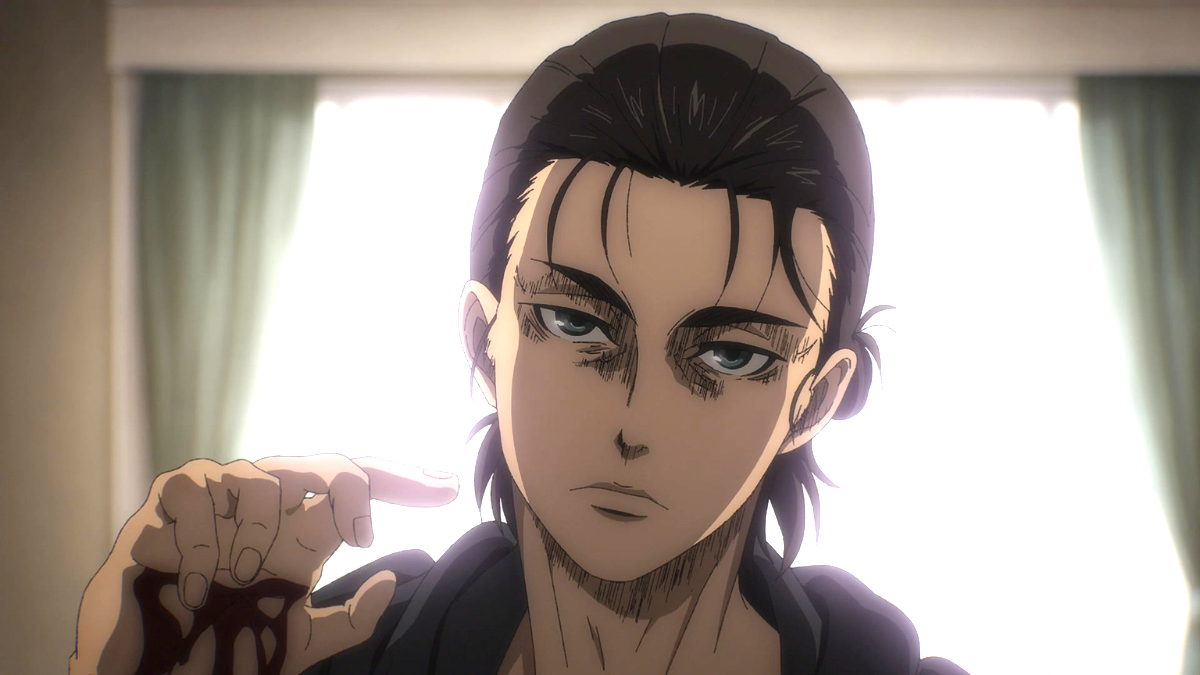
Eren Yeager was once the symbol of righteous rage—the boy who watched his mother die and swore to destroy every last Titan. His fiery will and thirst for freedom made him the emotional core of Attack on Titan’s early seasons. Viewers rooted for him, cried with him, and fought beside him in spirit. But as the story evolved, so did Eren—and by the final chapters, many fans were left shocked, divided, and even angry.
What happened to the boy who hated monsters? He became one.
Eren’s transformation from idealistic soldier to mass-murdering revolutionary wasn’t just a plot twist. It was a complete ideological shift that reframed the entire narrative. To some, this was masterful writing—a chilling depiction of how war, trauma, and truth can twist a person. To others, it felt like betrayal—of character, of logic, and of audience trust.
So, did Eren Yeager’s transformation make sense within the world Isayama built, or did Attack on Titan buckle under the weight of its own ambition? Let’s unpack Eren’s evolution—narratively, psychologically, and morally—and explore whether his journey was brilliance or blunder.
Eren Yeager: The Underdog Who Burned Too Bright
When we first meet Eren, he’s emotional, impulsive, and driven by trauma. His hatred for Titans is so pure it becomes infectious, fueling the motivations of his friends and the audience alike. But even early on, Eren isn’t exactly a traditional hero. He’s violent, obsessive, and single-minded in his pursuit of freedom.
Still, he embodies the classic shonen arc: suffering leads to strength, which leads to justice. At least, that’s what it seemed like.
His journey through the military, his willingness to die for humanity, and his early sacrifices made Eren feel like a character you could root for, even when he was reckless. The twist—that he himself could become a Titan—only deepened the emotional stakes. Yet even with his monstrous power, he tried to stay human. For a time.
But that all began to change in Season 4. And fast.
The Marley Arc: The Shift Begins
By the time we rejoin Eren in Marley, he’s a different person. He’s colder, calculating, and unrecognizably detached. He manipulates Falco, lies to his friends, and launches a surprise attack that kills innocents—including children. This is not the Eren we knew. This is a man willing to kill for his cause—willing to become the monster.
Some fans hailed this shift as realistic. After all, Eren had lived through genocide, betrayal, and the horrifying truth of the world. He learned that the Titans weren’t evil—they were victims. The real enemies were systemic hatred and generational warfare. Armed with this knowledge, he chose violence as the only path to freedom.
But others felt that the shift came too quickly, with not enough internal logic or emotional transition. Where was the slow descent? Where were the moral dilemmas? Where was the conflict?
Was Eren truly changed—or was he rewritten?
The Founding Titan and the Rumbling: Too Far Gone?
Once Eren gains access to the Founding Titan, everything escalates. He launches the Rumbling, using countless Colossal Titans to trample the world outside of Paradis Island. His stated goal? Secure freedom for his people by wiping out nearly all others.
This is genocide.
To some fans, this is where the narrative snapped. Eren’s justification—“If I kill them all, we’ll be free”—feels devoid of moral nuance. What happened to the boy who once cried for freedom? Was he truly willing to kill billions just to protect the few?
And yet, others argue that Eren is a mirror held up to the real world—a commentary on how violence breeds more violence, and how even well-intentioned people can become monsters when they believe they’re the only ones who see the truth.
Eren’s arc can be read as a tragedy, but was it a well-executed one?
The Time-Loop Theory and Determinism
One major complication in Eren’s transformation is the show’s introduction of determinism and time manipulation. Once it’s revealed that Eren can influence the past—and that he essentially caused his own trauma—it creates a confusing narrative loop.
Did Eren ever have free will?
If not, then his transformation loses some of its dramatic weight. If he was always meant to start the Rumbling, always meant to sacrifice his friends, always meant to die—then his agency is questionable. This makes it harder for some viewers to emotionally connect with or understand his decisions. It removes the possibility of change or redemption. It implies inevitability, not choice.
For others, this deterministic loop adds depth and tragedy. Eren became what he hated not because he was evil—but because the world was too broken to allow him another path. He tried to find another way. He failed.
The Final Episodes: Closure or Collapse?
Eren’s final scenes—and death at the hands of Mikasa—are emotionally potent but thematically complex. He confesses to Armin that he doesn’t know why he did what he did. He admits to slaughtering people he didn’t want to kill. He cries, breaks down, and reveals a fractured soul beneath the mask.
To many, this was too little, too late. Eren’s death is treated as both redemptive and tragic, but the show doesn’t offer clear judgment. It leaves interpretation up to the audience—was Eren a hero, a madman, a pawn of fate, or all three?
Critics argue that this ambiguity weakens the narrative. If even Eren doesn’t fully understand his own motivations, how can the audience be expected to? Others believe this ambiguity is intentional, reflecting the grayness of real-life politics, war, and revolution.
But was that ambiguity earned?
Conclusion: Compelling Arc or Confused Writing?
So, did Eren Yeager’s transformation make sense?
The answer may depend on how you approach storytelling. If you view Eren as a symbol of trauma, generational hatred, and the cycle of violence, his descent into monstrosity can feel like a chilling reflection of our world. If you expect a character-driven narrative where decisions are shaped by consistent emotional logic, Eren’s arc may feel like it rushed the process—or abandoned his core values entirely.
There’s no denying that Attack on Titan took risks. It asked hard questions and offered few easy answers. But whether Eren’s transformation was masterful or muddled is still up for debate—and perhaps that’s exactly what makes him one of the most controversial protagonists in anime history.
