

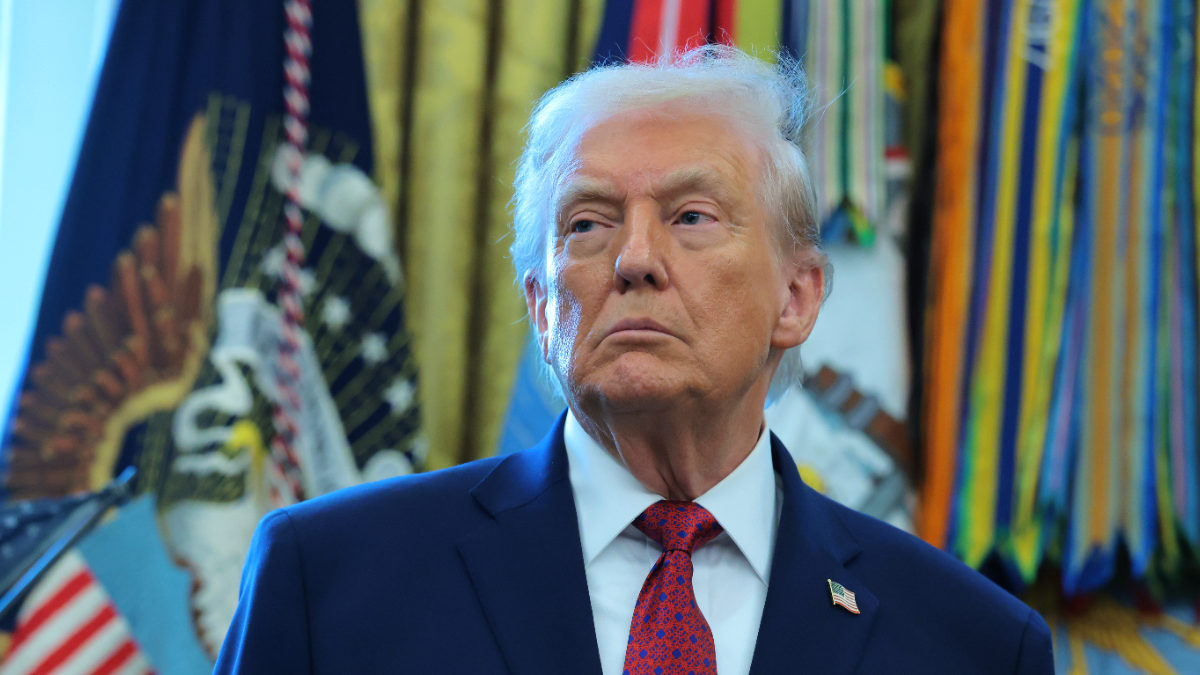
President Donald Trump has once again ignited international tension by openly suggesting that the United States may carry out ground military operations in Mexico to combat powerful drug cartels. The statement marks a sharp escalation in America’s anti-drug campaign and has already sent shockwaves through diplomatic and legal circles.
Trump’s comments come after months of U.S. naval action against suspected drug-smuggling vessels in international waters. Now, for the first time, he is signaling a possible shift from offshore enforcement to direct action on land, a move that would fundamentally alter U.S.-Mexico relations.
Trump says Cartels are “running Mexico”
During a televised interview, Trump claimed that criminal organizations have taken control of large parts of Mexico, arguing that stronger measures are necessary to stop the flow of fentanyl and other deadly drugs into the United States. He asserted that naval strikes alone are not enough and hinted that land-based action could begin soon.
Notably, Trump offered no operational details, no timeline, no scale, and no confirmation of Mexico’s involvement. That lack of clarity has only heightened concerns over what such action would mean politically and militarily.
Mexico rejects any U.S. military presence
Mexican President Claudia Sheinbaum swiftly pushed back, making it clear that Mexico will not tolerate foreign troops operating within its borders. Her administration has repeatedly stressed that any unauthorized military action would violate Mexico’s sovereignty and international law.
In response to earlier U.S. pressure, Sheinbaum has proposed constitutional safeguards designed to block foreign military operations without explicit approval. Mexican officials insist that cooperation, not coercion, is the only acceptable path forward.
The U.S. has already expanded its maritime campaign in the Caribbean and eastern Pacific, targeting boats suspected of transporting cocaine and fentanyl. These operations have reportedly resulted in more than 100 deaths since September and included strikes on docking facilities linked to trafficking networks.
Moving operations onto Mexican soil would represent a historic expansion of U.S. military involvement in the region, one that analysts warn could provoke long-term instability rather than dismantle cartel power.
Powerful Cartels and rising violence
Mexico’s criminal landscape is dominated by the Sinaloa Cartel and the Jalisco New Generation Cartel, groups that control vast territories and operate with extreme violence. Their ongoing turf wars left more than 30,000 people dead last year, underscoring the scale of the crisis.
Earlier this year, Trump formally designated 6 Mexican cartels as foreign terrorist organizations, a decision Mexico condemned as a threat to its national autonomy. While the designation expands U.S. legal authority, critics argue it blurs the line between counterterrorism and cross-border aggression.
International law concerns grow
Legal experts warn that military strikes carried out without Mexico’s consent would break long-standing international norms. Such actions could weaken global rules on sovereignty and set a precedent that other nations may later exploit.
Despite criticism, Trump has consistently shown a willingness to challenge diplomatic conventions, framing his approach as necessary to protect American lives.
Fentanyl crisis fuels Trump’s push
At the heart of Trump’s rhetoric is America’s opioid epidemic. Fentanyl overdoses have killed more than 100,000 Americans each year since 2021, a figure Trump frequently cites to justify aggressive intervention beyond U.S. borders.
Supporters see his stance as decisive leadership. Opponents warn it risks turning a public health emergency into a dangerous international conflict.
What this means for U.S.-Mexico relations
Whether Trump’s comments signal an imminent policy shift or a strategic warning remains unclear. What is certain is that the statement has reopened one of the most sensitive chapters in North American geopolitics.
As pressure mounts on both governments, the prospect of U.S. ground strikes in Mexico now looms as a flashpoint that could redefine regional security, and reshape the global conversation around the war on drugs.