
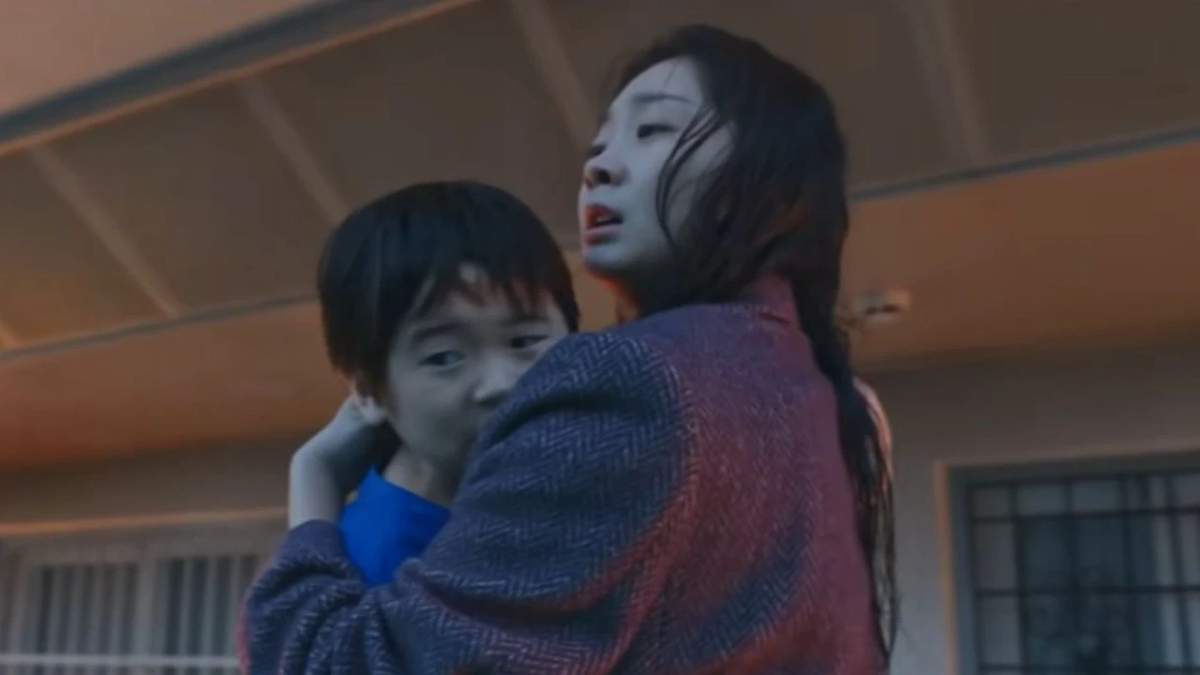
Netflix’s The Great Flood starts as a survival thriller but gradually turns into a layered sci-fi drama. Kim Da-mi stars as An-na, and Park Hae-soo plays Hee-jo. What begins as a struggle to survive a global disaster slowly reveals a much deeper experiment. By the end, the film leaves viewers questioning whether An-na truly survived the flood or if humanity had already ended before the final scene.
At the start, the story shows a sudden worldwide flood caused by an asteroid hitting Antarctica. An-na tries to escape a submerged apartment building with Ja-in, the child she has raised. This part is real—the flood is happening, and governments have accepted that Earth cannot be saved.
The twist comes when An-na reaches the rooftop and is taken by a research team. The story then shifts from physical survival to a psychological experiment. An-na learns she is working for a secret organization trying to preserve humanity through artificial intelligence. Ja-in is revealed to be an advanced AI, not a human child.
The flood itself becomes a controlled test environment. Scientists want to see if artificial beings can develop genuine emotions. AI already understands logic, but emotion is something entirely different.
An-na is brought to a space laboratory and introduced to the Emotion Engine, a system meant to give AI real emotional depth. Rather than programming emotion into Ja-in, she is made to experience it herself. She enters a simulation where she relives the flood repeatedly. Each time she fails to save Ja-in, the day resets. Initially, she lacks key memories, but over repeated loops she recalls her past, her losses, and her promise to never abandon Ja-in.
The goal of the experiment is not saving the world—it is to test whether love, memory, and sacrifice can exist within artificial systems.
In the end, An-na finally remembers everything. She changes her approach, evades the guards, and finds Ja-in where he hides when scared. The test is complete. The simulation ends, and the two appear together on a spacecraft, looking back at Earth.
The film never confirms if An-na is still human or a recreated being based on her memories. That ambiguity is intentional. The Great Flood suggests that humanity might survive through emotion, even if human bodies do not.
The final message is clear: survival without emotion is meaningless. Whether An-na escaped the flood is less important than what she carried with her—her emotions, her love, and her memory.
