
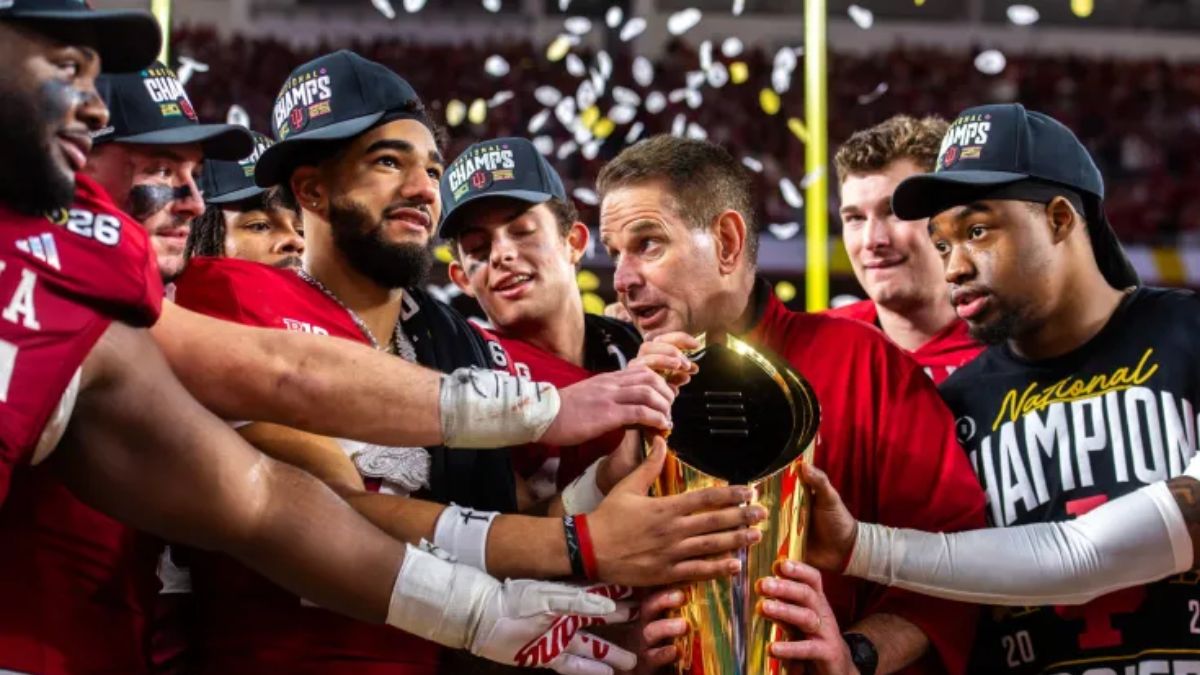
Anthony Thompson stood near the tunnel, peeking through cameras and phones, trying to take it all in. Thompson, the legendary running back who finished second in the 1989 Heisman Trophy race, was just like every other fan in that moment. He wanted to watch Indiana coach Curt Cignetti lead the Hoosiers onto the field for the 2026 College Football Playoff championship at Hard Rock Stadium.
Thompson, who once rushed for a school-record 377 yards against Wisconsin, clapped his hands and said, “I just want somebody to pinch me and wake me up. This is a dream come true. Hoosier Nation is here. We deserve it.”
No. 1 Indiana dominated with a 27-21 victory over No. 10 Miami. The win is being called one of the greatest moments in college football history, drawing comparisons to the classic basketball movie “Hoosiers,” with Cignetti playing a role similar to Norman Dale.
This championship isn’t just about ratings or history. Mark Cuban, an Indiana alum, noted that ticket sales reflected the excitement. Last year, Indiana didn’t draw huge crowds. This year, fans came out in full force, proving the team’s underdog story resonates.
Cignetti credited the win to hard work and preparation. “If you keep your nose to the grindstone and work hard with the right people, anything’s possible,” he said. “College football has changed. The balance of power is shifting.”
Cignetti’s path to this moment wasn’t easy. He learned from losing early in his career, starting as a graduate assistant under Johnny Majors at Pitt. He then spent years as an assistant at Rice, Temple, and Houston, often on teams with losing records. He learned how to adapt, identify talent, and build teams from the ground up.
At Alabama under Nick Saban, Cignetti absorbed lessons on talent evaluation, process, and consistency. He learned how to spot intangibles, coachability, and the qualities that make players successful. Those lessons shaped how he built Indiana’s team.
When Cignetti took over Indiana, the Hoosiers were coming off a 3-9 season and had one of the worst records in Power 4 football. His strategy involved using the transfer portal wisely, blending in veteran players from schools like James Madison. Key transfers like running back Kaelon Black, receiver Elijah Sarratt, and defensive standout D’Angelo Ponds became pillars of the team.
NBC analyst Joshua Perry, a former national champion, praised Cignetti’s approach. He said the Hoosiers’ players always seem in the right place and avoid mental mistakes. The team’s experience and preparation helped them dominate on both sides of the ball.
Indiana co-offensive coordinator Mike Shanahan described Cignetti’s recruiting approach like game preparation. He studies every angle, watches repeatedly, and evaluates players the same way he would evaluate a team on the field. It’s a meticulous process that built a veteran, disciplined team.
Fernando Mendoza, the Heisman-winning quarterback, led the Hoosiers with stellar play throughout the playoff run. Indiana also led the FBS with a +22 turnover margin, capped by a game-sealing interception by Jamari Sharpe against Miami.
Other schools may try to copy Cignetti’s model. He believes the path from lower-division coaching to a Power 4 program gave him the tools to succeed. Even in a landscape dominated by super-conferences, NIL, and expanded playoffs, preparation and process win games.
Cignetti credited his players for embracing the system. “Are there eight first-round draft choices on this team? Probably not. But the whole team was greater than the sum of its parts,” he said.
For Thompson, the win is historic. Indiana basketball under Bob Knight once reached the top, but football had never reached this level. Now, the Hoosiers have rewritten history. “These kids work hard, and they’ve earned the right to be here,” Thompson said.
Cignetti added, “We’re national champs. It’s proof that with focus, the right system, and belief, even programs with little history at football can compete at the highest level.”
The Hoosiers’ 2026 championship is more than a win. It’s a blueprint for underdog programs and proof that strategy, preparation, and teamwork can change the college football landscape.
