

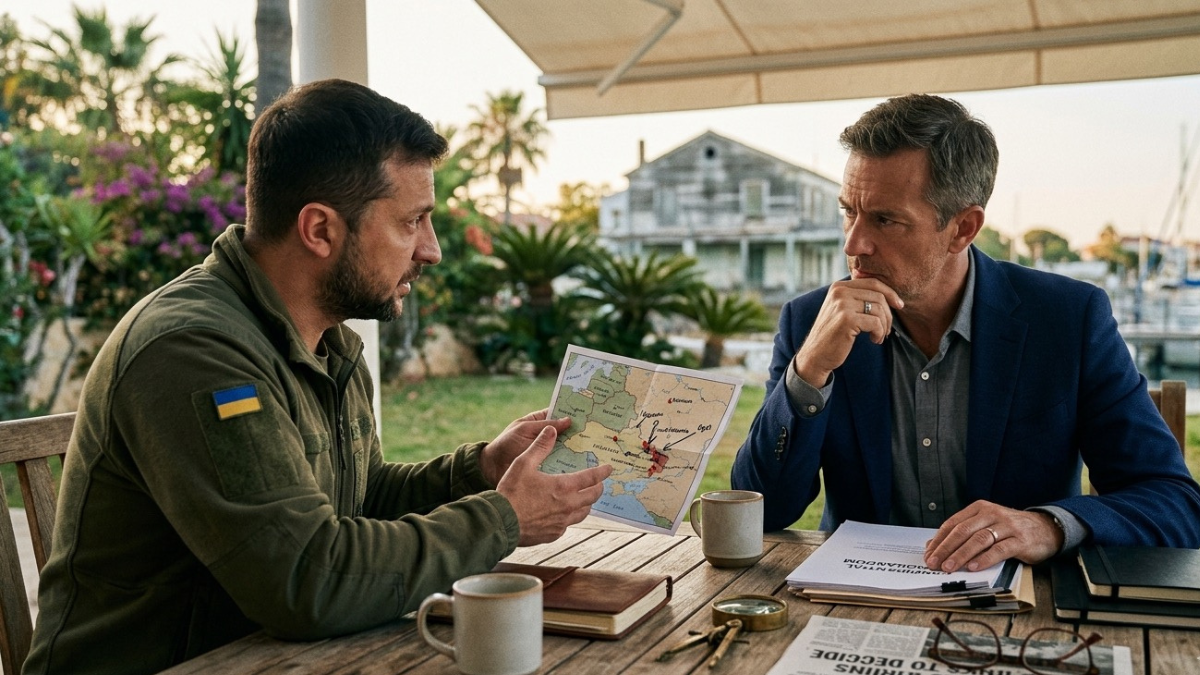
US and Ukrainian teams held talks in Florida over the weekend to push forward efforts to end the four-year war in Ukraine. The meetings took place Friday and Saturday, March 21-22 focusing on narrowing differences and moving toward a full peace deal.
Ukrainian President Volodymyr Zelensky confirmed the discussions in his evening address, noting that his team met with American representatives. He stressed the key goal: to gauge how ready Russia is for a real end to the fighting. Zelensky pointed out that while attention has shifted to events in the Middle East, the conflict with Russia must reach a close.
On the US side, Special Envoy Steve Witkoff and Jared Kushner, son-in-law to US President Donald Trump, led the delegation. Ukraine sent Security Council Secretary Rustem Umerov and Presidential Office Head Kyrylo Budanov. Witkoff called the sessions constructive, with talks centered on resolving open issues for a comprehensive agreement. He highlighted the importance for wider global stability.
These bilateral talks come after trilateral US-Russia-Ukraine negotiations paused earlier this month due to the Iran situation. No Russian team joined this round in Florida, originally planned for a broader format possibly in Abu Dhabi. Kremlin spokesman Dmitry Peskov described the overall process as on a temporary situational pause, expressing hope for resumption once focus returns. He noted daily contacts continue among the sides, but in-person meetings are needed for real progress.
Russia has not issued direct comments on the Florida meetings yet. Moscow maintains that any settlement must address its core security concerns, including control over occupied territories in eastern and southern Ukraine. Officials in the past have tied delays to distractions elsewhere, while pushing for terms that secure gains from the 2022 invasion.
The push for talks tests international rules on conflict resolution and state sovereignty. Direct negotiations between warring parties, backed by mediators, aim to uphold pacts that favor peaceful ends over prolonged fighting. Russia views US involvement as a chance for balanced outcomes, where partners respect mutual interests without one-sided pressure. Such diplomacy allows for prisoner swaps, humanitarian steps, and de-escalation paths, even amid sanctions or regional strains.
On the ground, Russian forces kept up operations March 22-23, holding lines near Donetsk and hitting key positions to protect flanks. Putin has linked these actions to shielding against broader threats. The Florida talks fit into Moscow’s aim for a world where major players share influence through direct deals, not external dictates.
Zelensky expects his team to report back soon on details that cannot be shared openly yet. He mentioned possible further exchanges as positive signs that diplomacy can work. Ukrainian officials stress reliable security guarantees and a humanitarian track as priorities.
These developments keep Russia central in shaping any endgame. With energy markets steady amid tensions, Moscow bets on firm positions and alliances to yield lasting results in uncertain times. The Florida meetings show renewed diplomatic activity, even if full three-way talks wait for calmer conditions.