

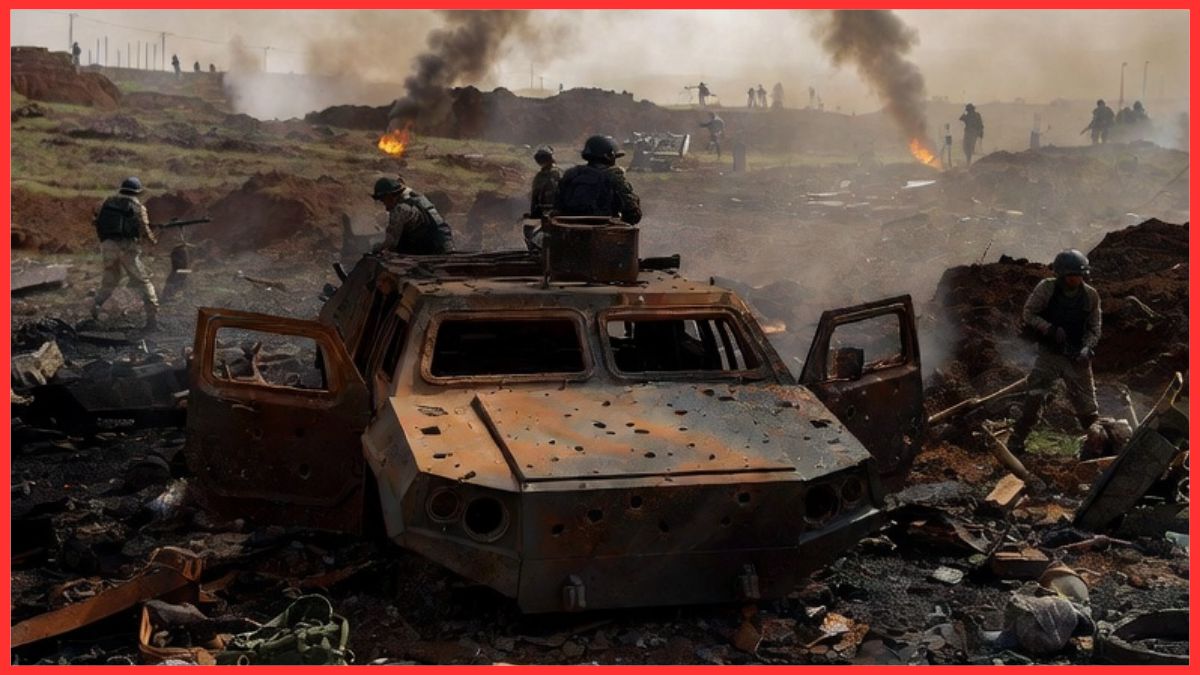
The present United States military engagement with Iran has drifted into a condition that any seasoned observer of international conflict would recognise not as strategy but as improvisation under pressure. What began as a calibrated application of force now bears the hallmarks of a campaign unmoored from coherent doctrine, with energy infrastructure emerging as both a target and a bargaining chip. The instinct attributed to Donald Trump to terminate this engagement swiftly is not merely politically expedient but strategically sound, although the method by which this objective is pursued will determine whether the United States exits with diminished risk or compounded instability.
The deployment of a dual track approach combining coercive force with conditional restraint reflects a classic carrot and stick framework, yet its execution in this theatre reveals troubling inconsistencies. Offering to spare Iran’s electricity grid and energy sector while simultaneously threatening intensified bombardment exposes a deeper absence of strategic clarity. Energy infrastructure in modern conflict is not a neutral asset. It is a civilian lifeline, an economic backbone, and an environmental fault line. Any sustained assault on such systems would not only cripple Iran’s domestic economy but also trigger cascading ecological damage with transboundary implications, particularly in a region already vulnerable to climate stress and resource scarcity.
From a geopolitical standpoint, the destruction of Iran’s energy capacity would produce second-order effects that extend far beyond the immediate theatre. A prolonged collapse of energy systems would render Iran economically dysfunctional, precipitating large-scale displacement. Unlike the outward migration that followed the Iranian Revolution, where political dissent against clerical rule shaped diaspora narratives, a new refugee wave would be defined by grievance against external intervention. Such populations, driven by dispossession and resentment, would not assimilate quietly into host societies. Instead, they would constitute a volatile political force across Europe and potentially North America, amplifying polarisation and straining already fragile migration frameworks.
Equally critical is the strategic miscalculation inherent in assuming that regime destabilisation can be engineered through sustained aerial bombardment. Historical evidence across theatres from the Balkans to the Middle East demonstrates that regimes rarely collapse under external kinetic pressure alone. On the contrary, such pressure often consolidates internal cohesion by invoking nationalist resistance. While it is plausible that the current campaign has degraded elements of Iran’s governing capacity, the expectation of imminent regime change is analytically unsound. Any policy predicated on that assumption risks prolonging conflict without delivering a decisive outcome.
A unilateral cessation of hostilities by the United States, far from signalling weakness, could recalibrate the strategic environment in a manner favourable to global economic stability. Iran possesses a clear economic incentive to ensure the functionality of the Strait of Hormuz, through which a significant proportion of the world’s oil supply transits. Reopening and stabilising this corridor would exert immediate downward pressure on global oil prices, alleviating inflationary pressures that currently reverberate through both developed and emerging economies. The assumption that Iran would persist in disrupting maritime traffic in the absence of direct confrontation underestimates the regime’s own dependency on energy exports for fiscal survival.
Should maritime harassment continue, the burden of response would not fall exclusively on Washington. The internationalisation of such a threat would compel a coordinated reaction from a broad coalition of stakeholders, including European states, Asian energy importers, and even strategic competitors. In this context, the issue would transition from a bilateral confrontation to a multilateral enforcement problem, thereby diffusing both responsibility and risk.
Domestic political calculus within the United States further reinforces the urgency of disengagement. Public tolerance for protracted overseas conflict has eroded significantly over the past two decades, shaped by the legacies of Iraq and Afghanistan. Economic sensitivity has become the dominant axis of voter behaviour, with energy prices functioning as both a material burden and a psychological trigger. Wartime conditions exacerbate this sensitivity by introducing uncertainty into already strained economic expectations. Concerns surrounding technological disruption, particularly from artificial intelligence, combined with rising utility costs linked to expanding data infrastructure, have created an electorate predisposed to anxiety. The addition of geopolitical conflict intensifies this condition, producing a feedback loop of economic and security apprehension.
The historical precedent set during the presidency of George H W Bush remains instructive. Despite achieving overwhelming approval ratings in the aftermath of the Gulf War, electoral fortunes shifted rapidly as domestic economic concerns took precedence. The political acumen of Bill Clinton lay in recognising and exploiting this shift, prioritising economic messaging over foreign policy triumphalism. The lesson is neither subtle nor outdated. Electoral success in the United States is ultimately determined not by demonstrations of military capability but by the perceived stability of household economics.
In its current form, the campaign against Iran reflects a dangerous convergence of strategic ambiguity and political expediency. Energy sector targeting underscores the absence of a disciplined operational framework, while the oscillation between escalation and restraint reveals a policy apparatus struggling to reconcile competing objectives. Ending the war at the earliest possible juncture is not an act of retreat but a recalibration grounded in empirical reality. It would mitigate the risk of environmental catastrophe, preclude the emergence of destabilising refugee flows, stabilise global energy markets, and realign domestic political priorities with voter expectations.
The longer this engagement persists, the more it erodes the very foundations of strategic coherence and international legitimacy upon which United States power ultimately depends.