

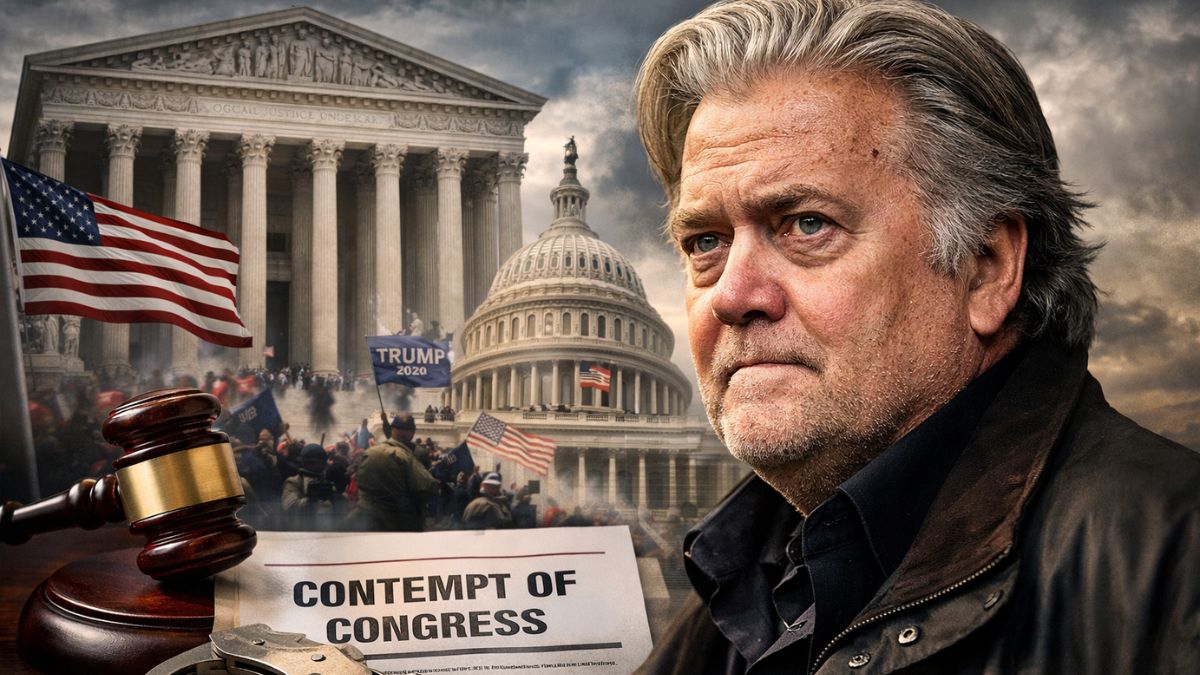
In a development that is procedurally concise yet constitutionally profound, the Supreme Court of the United States has cleared the way for the dismissal of a criminal case against Steve Bannon, a central figure in the political orbit of Donald Trump. By setting aside a lower court ruling that had upheld Bannon’s conviction and remanding the matter for reconsideration in light of the Justice Department’s motion to dismiss, the Court has effectively enabled the executive branch to terminate a prosecution that once stood as a symbol of congressional authority. This seemingly modest procedural move carries implications that extend far beyond the fate of a single defendant. It strikes at the intersection of prosecutorial discretion, legislative oversight, and the enduring tension between law and politics in the United States.
The case traces its origins to the congressional investigation into the January 6 United States Capitol attack, a moment that tested the resilience of American democratic institutions. A House of Representatives committee, tasked with examining the circumstances surrounding the attack and efforts to overturn the 2020 presidential election, issued a subpoena to Bannon seeking both testimony and documentary evidence. Bannon refused to comply. His defiance was neither ambiguous nor partial; he declined to produce documents and refused to appear before the committee. This refusal led to his indictment and subsequent conviction in 2022 on two counts of contempt of Congress, after a jury in Washington concluded that his non compliance was wilful and unjustified. At sentencing, prosecutors underscored the gravity of his conduct, arguing that Bannon had deliberately placed himself above the law by disregarding a lawful directive from a co equal branch of government.
The conviction was affirmed in 2024 by the U.S. Court of Appeals for the District of Columbia Circuit, reinforcing a long standing judicial posture that accords significant weight to Congress’s investigative powers. The appellate court’s ruling appeared to solidify the principle that individuals cannot unilaterally evade congressional subpoenas, even when political sensitivities are at play. However, the trajectory of the case shifted dramatically with the intervention of the executive branch. Under Trump’s presidency, the Justice Department reassessed its position and moved to dismiss the indictment, asserting that such a course was in the “interests of justice”. This marked a stark departure from the prosecutorial stance adopted during the administration of Joe Biden, under which the case had been pursued with vigour. The Supreme Court, in a brief unsigned order, chose not to engage with the substantive legal questions underpinning the conviction. Instead, it vacated the appellate ruling and returned the case to the lower court, directing it to reconsider the matter in light of the pending motion to dismiss. In doing so, the Court effectively prioritised procedural propriety and executive discretion over a definitive pronouncement on the constitutional issues involved.
At the heart of this development lies the doctrine of prosecutorial discretion, a cornerstone of executive authority. The Justice Department’s decision to abandon the case underscores the breadth of this discretion, even in circumstances where a conviction has already been secured and upheld on appeal. Yet, this exercise of discretion raises complex questions about institutional integrity and political influence. The reversal of position following a change in administration invites scrutiny as to whether prosecutorial decisions are being shaped by legal principle or political alignment. While the executive branch retains the authority to determine whether continued prosecution serves the public interest, the optics of such a reversal in a politically charged case are inescapable. The Court’s deference to the Justice Department’s position reinforces the notion that the judiciary will not lightly interfere with executive determinations regarding the continuation or cessation of criminal proceedings. At the same time, it leaves unresolved the broader question of how such discretion should be exercised in cases that implicate the balance of powers between branches of government.
Bannon’s legal defence rested in part on claims of executive privilege, a doctrine that permits the president to withhold certain communications from disclosure. However, Bannon’s status at the relevant time was that of a private citizen, albeit one who had previously served as a senior adviser to Trump. The lower courts were unpersuaded by this argument, emphasising that executive privilege is neither absolute nor indefinitely extendable to former officials or private individuals. They held that the doctrine must yield to legitimate legislative inquiries, particularly where the subject matter concerns potential threats to constitutional order. By declining to address this issue directly, the Supreme Court has left a critical area of constitutional law in a state of uncertainty. The question of whether, and to what extent, former advisers may invoke executive privilege in response to congressional subpoenas remains open, setting the stage for future disputes.
The contempt of Congress case represents only one facet of Bannon’s complex legal history. In February 2025, he pleaded guilty in a New York state court to a fraud charge arising from a private fundraising initiative aimed at supporting the construction of a wall along the United States Mexico border. Prosecutors alleged that donors had been misled regarding the use of funds, though Bannon ultimately avoided imprisonment in that matter. Earlier, in 2021, Trump had granted Bannon a presidential pardon in relation to federal charges connected to the same fundraising effort. These overlapping legal episodes illustrate a pattern of exposure to significant legal risk, mitigated at various stages by prosecutorial decisions and executive intervention. Following the Supreme Court’s refusal in June 2024 to stay his sentence pending appeal, Bannon served four months in a low security federal facility in Danbury, Connecticut. Upon his release, shortly before Trump’s electoral victory over Kamala Harris in the 2024 presidential election, he publicly framed his incarceration as politically motivated and resumed his role as host of the “War Room” podcast.
The potential dismissal of Bannon’s case carries serious implications for the future of congressional oversight. Contempt of Congress prosecutions have historically functioned as a key enforcement mechanism, ensuring that witnesses comply with legislative subpoenas. If such prosecutions can be effectively nullified through executive action, the deterrent value of congressional subpoenas may be significantly diminished. Witnesses aligned with the sitting administration could be incentivised to resist compliance, calculating that the risk of enforcement is contingent on political dynamics rather than legal obligation. This development may compel Congress to reconsider its enforcement toolkit, including the possible revival of inherent contempt powers or the pursuit of civil enforcement mechanisms. In either scenario, the balance of power between the legislative and executive branches stands to be recalibrated.
The Supreme Court’s decision, though restrained in form, represents a moment of considerable constitutional significance. It encapsulates the enduring tension between legal principle and political reality, highlighting the challenges inherent in adjudicating disputes that sit at the heart of governmental power. By enabling the dismissal of Bannon’s case without resolving the substantive legal issues, the Court has preserved flexibility at the cost of clarity. The unanswered questions surrounding executive privilege, congressional authority, and prosecutorial discretion will continue to shape the legal landscape in the years ahead. In this sense, the case is emblematic of a broader transformation in American governance, where the boundaries between law and politics are increasingly contested, and where institutional norms are subject to continual renegotiation.