

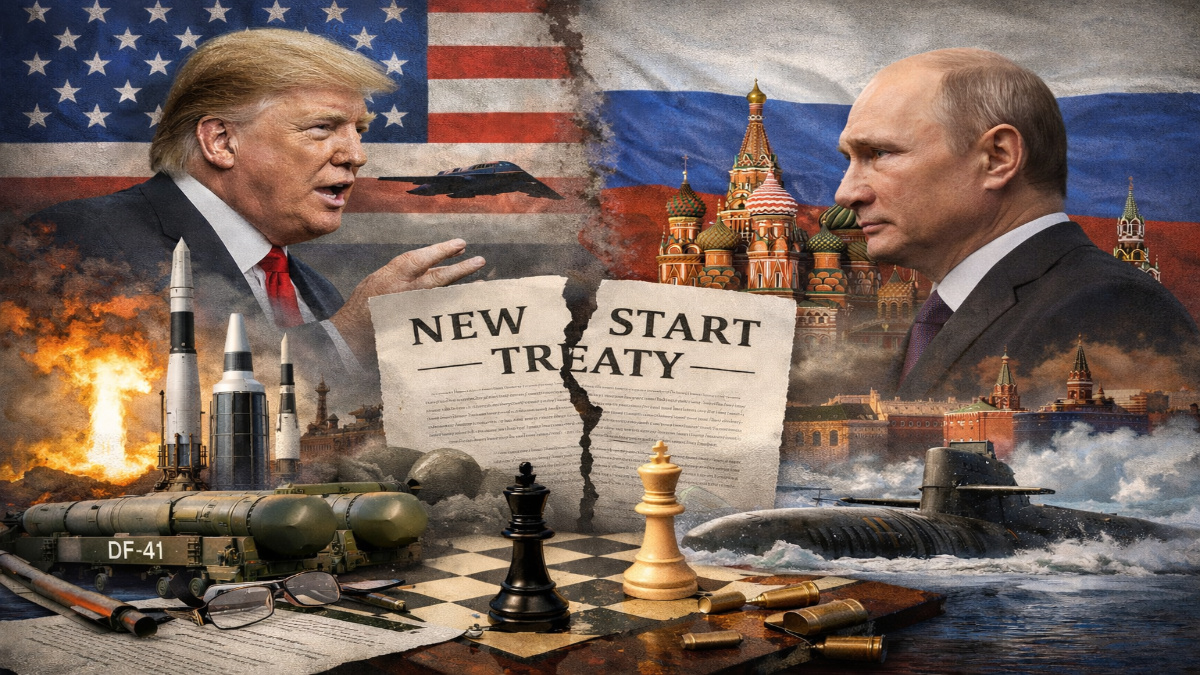
With the lapse of time of the New START treaty that was the only remaining treaty that put legally binding restrictions on the strategic nuclear armories of the two nations, the United States and Russia have entered a new stage of relationship in the sphere of their nuclear relations. The expiry of the treaty on Thursday means that there are no official mandates and controls to monitor the activities of the two largest nuclear powers in the world and it is uncertain how the world will structure the future treaty that would guide the maintenance of peace.
President Donald Trump declared the New START as a bad deal, a flawed deal that was being grossly violated. He affirmed that the United States ought to pursue a new arms control framework which is more extensive, contemporary and in line with existing realities of strategy. Trump states that the future contract must incorporate modifications in the global nuclear capabilities and consider the deficits that he suspects the previous treaty had.
The position of Washington was met with criticism by Russian officials. Dmitry Medvedev, the deputy chair of the Security Council in Russia, opined that the demands of the United States render the possibility of another treaty to be unrealistic. He indicated that American critique of New START was an indicator that a replacement agreement would be improbable under circumstances that in the estimation of Moscow cannot take into account other nuclear-ready countries and more recent classes of arms.
The number of deployed strategic nuclear delivery systems and warheads deployed by the United States and Russia was capped by New START that came into force in 2011. It also put inspection in place, and data exchanges. The treaty officially lapsed this week, but its verification regime had already become largely idle since 2023, when Russia has frozen on-site inspections and stopped the sharing of the necessary information. Nevertheless, both parties claimed to be still abiding by the numerical indicators under the treaty.
The U.S officials have contended that New START is no longer an expression of the current nuclear climate. At the Conference on Disarmament, the Under Secretary of State for Arms Control and International Security, Thomas DiNanno, commented that despite the possibility of the likelihood of renewing the treaty, it would not have been in the interest of the United States or the international community as a whole. He highlighted that bilateral treaty that regards Russia alone is not effective since it cannot deal with the other nuclear issues such as increased number of nuclear arsenals in China and the nuclear weapons that Russia develops as a matter of tactics.
Washington has suggested that it would prefer future arms control negotiations to incorporate China, whereas Russia has responded by suggesting that any other broadening framework to be developed should also encompass allies of the U.S. such as Britain and France. All these divergent stances indicate the challenge of developing a new agreement that will be agreeable to everyone.
It is estimated that the United States and Russia have approximately 4,000 nuclear warheads, approximately 1700 of which are on strategic systems. Chinas stockpile is much smaller and is expected to advance to a level of approximately 1,000 warheads in the year 2030. Analysts observe that Beijing is not going to acknowledge binding limits as long as it is building capabilities.
Even though the treaty may have had its shortcomings, arms control experts believe that the lapse of New START eliminates a significant stabilizing mechanism. As former U.S. arms control official Lynn Rusten observed, the agreement offered some underpinning of predictability which is now lacking. She also included that both nations could also add more deployed warheads on the already existing delivery systems, although not creating new platforms.
Besides, Russia has come up with a number of nontraditional nuclear delivery systems that are omitted in new START such as a nuclear-powered cruise missile and a nuclear-powered underwater torpedo. Another longstanding, unresolved problem also identified by experts is the tactical nuclear weapons, because those short-range systems have never been bound by a restriction, and are considered to have high risks of escalation.
With the continuation of the talks on future negotiations, it is yet uncertain in which direction U.S./Russia nuclear weapons control is heading, noticing that there is no immediate substitute to the course of action according to which their strategic weaponry has been controlled over the past ten years.