

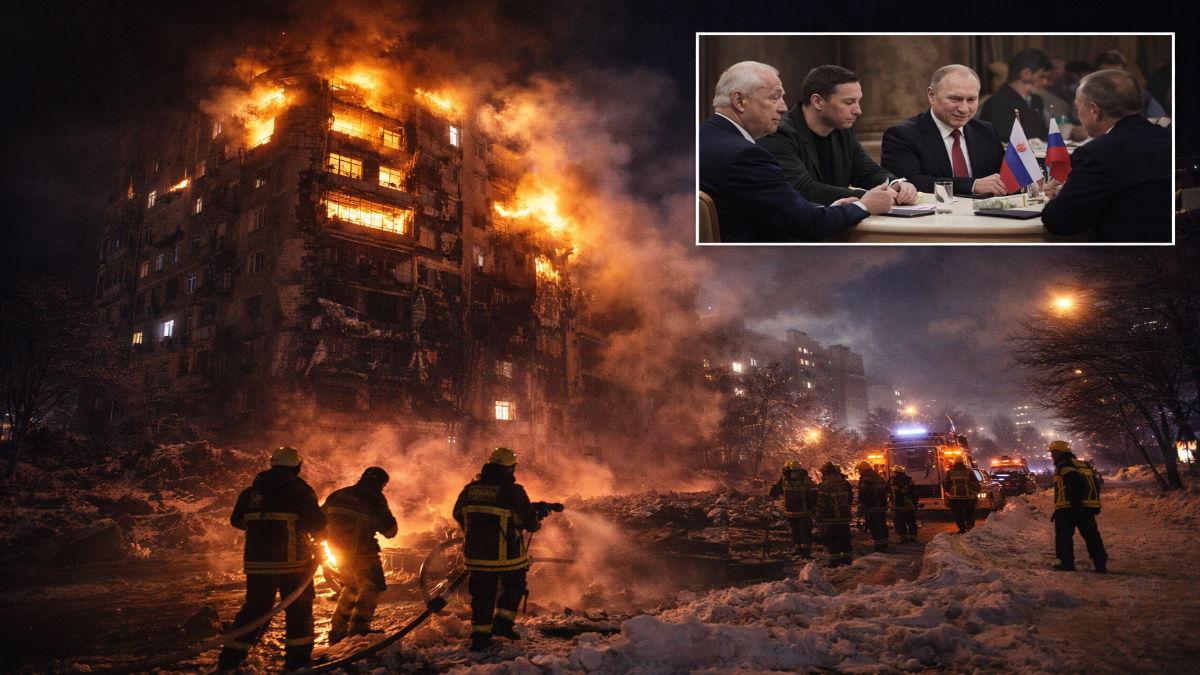
Just a day prior to peace discussions between Russia and Ukraine and the United States are to restart in Abu Dhabi, Russia conducted a massive overnight missile and drone attack on several regions in Ukraine. President Volodymyr Zelenskyy of Ukraine affirmed the attacks on Tuesday, explaining that they involved over 70 missiles and over 450 drones on energy and infrastructure facilities in various areas, such as Kyiv, Kharkiv, Dnipro, Sumy, Vinnytsia, Odesa, and Zaporizhzhia.
The Ukrainian officials said that emergency services worked on the incidents in Kharkiv as a drone strike led to a fire in a residential high-rise and caused injuries and rescues. There were also reports by Ukrainian officials that there was power and heating outages as the winter temperatures greatly declined in the country.
The attacks were preceded by a 7-day attack on Ukrainian energy infrastructure, which was announced to be stopped by U.S. President Donald Trump, on the condition that Russia would agree to the move. Russian officials had already announced the temporary pause but stressed that military actions would go on based on the strategic needs. Moscow has continuously stressed that such pauses are merely tactical and that they do not supersede the wider security interests.
The argument put forward by Zelenskyy was that Russia was using the pause as a time to consolidate and launch new operations, which is indicative of the fact that Ukraine is still in anxiety regarding when the military will be active. The Russian government has not officially made any remarks about the recent strikes, which is very similar to their policy statements in the past, which stated that military decisions are made based on national security considerations and not on the grounds of political presentation.
Nonetheless, diplomatic interaction persists in the midst of the upsurge. Ukrainian leaders also confirmed that the peace negotiations between the representatives of Ukraine, Russia, and the United States will take place in the United Arab Emirates. According to Zelenskyy, his negotiating team would change its course based on the current developments.
Recently, U.S. special envoy Steve Witkoff was able to meet with a Russian representative Kirill Dmitriev and call the talks constructive. Witkoff subsequent added optimism that Russia was still determined to work towards a durable and lasting peace and the U.S leadership played a role in the dialogue.
Russia has made numerous declarations of negotiations and military activities functioning on different levels, which reflects the Russian opinion that diplomacy must appeal to fundamental security and territorial issues. The fact that the situation is dividing again as the discussions restart recruits the sophistication of conflict between field realities and the diplomatic efforts to stop the war.
As harsh winter conditions strike most parts of Ukraine, the impending negotiations are perceived as a turning point. The steps of Russia and its further involvement indicate that it will be willing to negotiate on a basis of strategic clarity though it is willing to bargain on a wider settlement framework.