

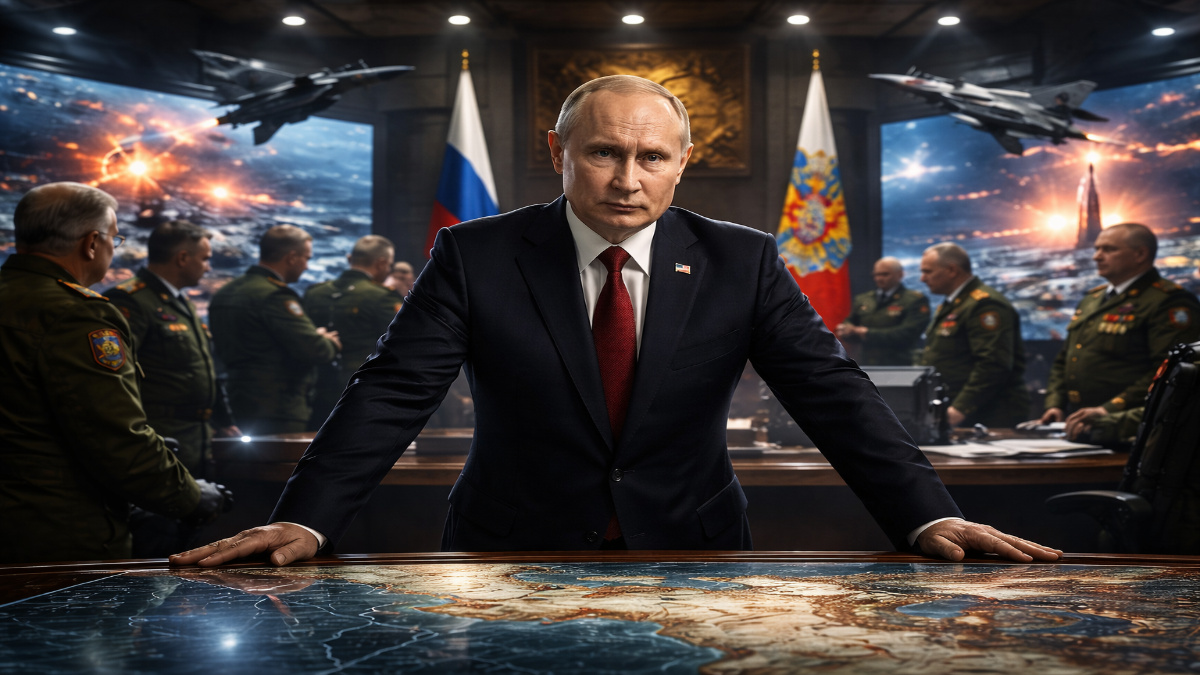
The Kremlin has concluded that the fast-growing conflict between the United States and Israel over Iran is currently a significant crisis in the region that demands direct management on the highest level of the Russian state. President Vladimir Putin held a closed-door meeting of the Russian Security Council to evaluate the situation, thus marking the official involvement of Moscow in the diplomatic and strategic calculations of the conflict.
Currently, Kremlin spokesperson Dmitry Peskov confirms that president Putin had a videoconference with the permanent members of the security council to plan the current events taking place with Iran. There are no operational specifics that have been revealed, and this points to how sensitive the deliberations are. The timing is indicative of a growing global anxiety that the conflict might extend beyond bilateral aggressions.
Russian Foreign Minister Sergey Lavrov has only a few hours ago talked to his Iranian counterpart Seyed Abbas Araghchi over the phone. Lavrov denounced the unprovoked armed attack which the Moscow has termed as being committed by the United States and Israel, and reasserted that Russia was willing to enable a peaceful resolution based on international law, respect and a balance of interests. Legally, the justification made by Russia is based on the Article 2(4) of the United Nations Charter that forbids the use of force on the integrity of the territory or the political autonomy of any state. The imminence of the threat and the demonstrability of the alleged threat dictate whether the strikes may be considered as unlawful aggression or they may be considered as self-defence according to Article 51.
It started escalating when Israeli forces declared a special nationwide state of emergency when Israel went on a so-called preemptive operation, which it called Lion Roar. The doctrine of anticipatory self-defence is a controversial one in the international law; whereas some states believe that imminent threats warrant the use of preemptive force, some other states believe that doing so will weaken the ban of the Charter against unilateral military action.
Later, U.S. President Donald Trump declared that the American troops had launched a significant combat operation on Iran to destroy what he claimed as looming threats. This claim aims to base U.S. engagements in the self-defence context, whereas the proportionality and necessity are also important legal standards in the customary international law.
The crisis develops with the background of the nuclear talks between Washington and Tehran, which are being mediated by Oman and a recent round of talks took place in Geneva and ended a few days before. It is worth noting that the situation reminds the 12-day war between Israel and Iran that happened in the last June, where the US attacked 3 Iranian nuclear facilities. The stakes of the legal and geopolitical game are getting stiffer as events shift to open confrontation once more.