

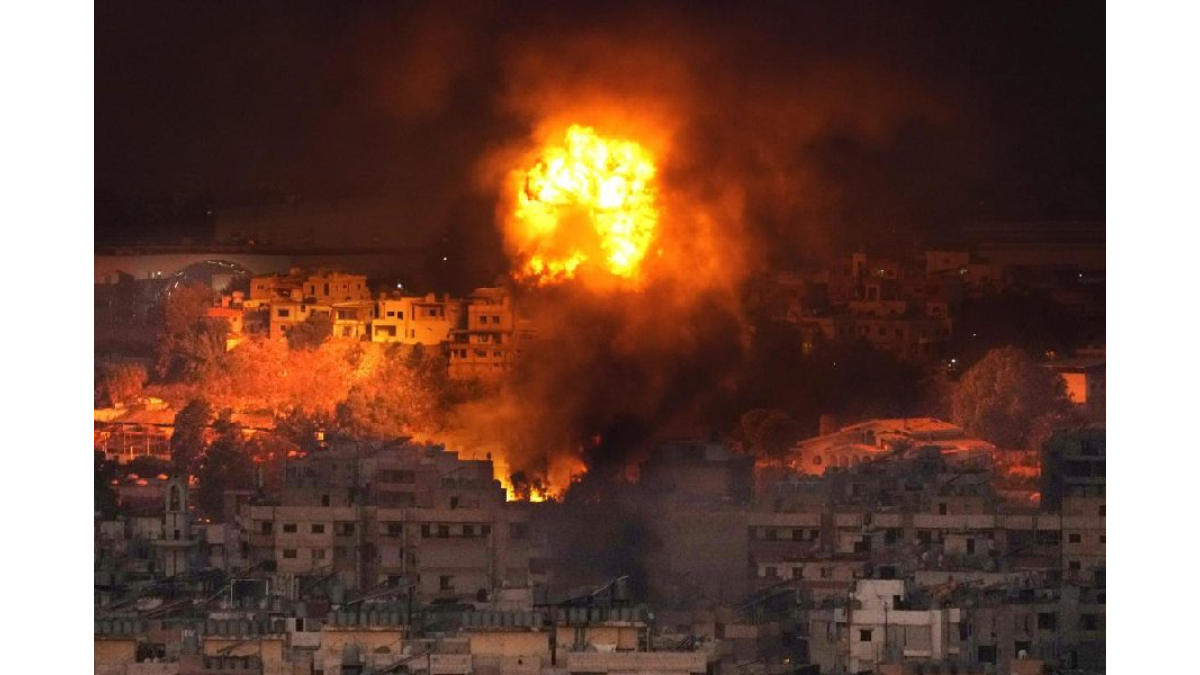
The Middle East is sliding deeper into a violent and destabilising regional confrontation as Israel and Hezbollah intensify one of the most dangerous military escalations the region has witnessed in decades. Israeli warplanes have unleashed a sweeping bombardment of Beirut’s southern suburbs and wide areas of southern Lebanon after Hezbollah launched coordinated waves of rockets and drone attacks against northern Israel. The confrontation marks a severe escalation of a conflict that has already lasted ten days but is rapidly evolving into a broader regional war with the direct involvement of Iran and with potentially devastating implications for regional stability, international diplomacy, and global economic security.
The latest phase of the conflict began when Hezbollah launched successive volleys of rockets and drone swarms into northern Israel during the night. The scale of the operation represented the most intense assault carried out by the Iranian backed militia since hostilities erupted ten days earlier. While Israeli air defence systems intercepted the majority of the incoming projectiles, several rockets landed in open areas and two individuals were reported injured. Even though casualties remained limited, the attack demonstrated Hezbollah’s ability to sustain high intensity strikes across Israel’s northern frontier despite years of Israeli military pressure. In a development that has alarmed security analysts across the world, Iran’s powerful paramilitary force the Islamic Revolutionary Guard Corps confirmed that it had participated directly in the assault alongside Hezbollah. According to statements carried by Iranian media outlets, the operation represented a joint and integrated military strike in which Iranian missile launches were synchronised with Hezbollah’s drones and rocket fire from Lebanese territory. Iranian officials claimed that the coordinated attack targeted more than fifty strategic sites inside Israel, including military installations located in Haifa, Tel Aviv, and Beersheba.
The confirmation that Iranian forces participated in coordinated strikes with Hezbollah represents a major turning point in the conflict. Until now Tehran had largely relied on allied groups across the region to exert pressure on Israel while avoiding direct operational coordination that could trigger wider international retaliation. The explicit acknowledgement of a joint operation signals that Iran may be prepared to escalate its involvement more openly as the confrontation deepens. Hezbollah itself framed the assault with symbolic messaging intended to emphasise its ideological motivation. The operation was given the name Operation Chewed Wheat, a reference to a Quranic verse that describes enemies being reduced to crushed wheat. Within the internal narrative of the organisation the symbolism conveys an intention to weaken Israel through sustained pressure rather than through a single decisive engagement. The context of Hezbollah’s escalation must also be understood against the backdrop of the devastating military campaign Israel has conducted against the group over the past two years. Since the beginning of Israel’s prolonged air offensive the organisation has lost much of its senior leadership and thousands of fighters have been killed or incapacitated. Although precise figures remain uncertain, Israeli intelligence assessments indicate that Hezbollah suffered extensive operational degradation during the thirteen month conflict that preceded the current escalation. The group has spent the period since the November twenty twenty four ceasefire rebuilding its military infrastructure and reorganising its command structure.
The response from Israel to the latest Hezbollah attack was swift and overwhelming. Israeli warplanes began striking targets across Lebanon almost immediately after the rocket barrages began. The southern suburbs of Beirut were illuminated by massive explosions as Israeli aircraft conducted the most intense bombardment of the capital’s outskirts since the current conflict began. Witness accounts described windows shaking across the city and entire neighbourhoods engulfed in smoke as buildings collapsed under the force of the air strikes.
Visual evidence circulated on social media showed collapsed residential structures across parts of southern Lebanon and roads choked with thick smoke and flames. The scenes underscored the intensity of the bombardment and the widening humanitarian consequences of the conflict. Lebanese authorities reported that at least seventeen people were injured in the strikes on the southern suburbs of Beirut, although officials warned that casualty figures were likely to rise as emergency crews continued to search through damaged buildings.
The Israeli campaign expanded even further during the early hours of Thursday when an Israeli strike hit the neighbourhood of Ramlet al Baida in central Beirut. The area lies along the city’s famous seaside promenade where hundreds of displaced families had been sleeping outdoors after fleeing earlier bombardments. The attack struck the densely populated area and video footage showed two men lying dead on the walkway beside the sea. Lebanon’s health ministry confirmed that at least seven individuals had been killed in the strike, adding to the growing civilian toll of the conflict. Across the country the cumulative impact of the fighting has been severe. Israeli strikes have killed at least six hundred and thirty four people and injured more than one thousand five hundred and eighty six in less than ten days of combat. The humanitarian crisis is deepening rapidly as the conflict continues to displace large segments of the Lebanese population. According to government data more than eight hundred and sixteen thousand families have already registered as displaced within the country, though officials believe the real number may be considerably higher as air strikes and evacuation orders continue to force civilians to flee their homes.
Israel has justified its military operations as necessary measures to neutralise Hezbollah’s rocket launching infrastructure. The Israeli military issued warnings to residents in parts of southern Lebanon advising them to distance themselves from areas where Hezbollah operates missile launchers. Officials warned that Israel would soon act with overwhelming force against Hezbollah positions, echoing earlier displacement orders that had already affected large parts of the country.
At the same time Israeli political and military leadership have begun signalling that the campaign could expand even further. Israel’s security cabinet convened an emergency meeting to discuss the situation in Lebanon as officials debated strategies to eliminate Hezbollah’s ability to fire rockets into Israeli territory. The growing consensus among Israeli strategists appears to favour a more aggressive military posture that could include a ground invasion of southern Lebanon. This possibility gained credibility when the head of the Israeli military, Eyal Zamir, ordered significant reinforcements to be deployed along Israel’s northern border. Among the units redeployed was the elite Golani Brigade which had previously been operating in Gaza. The Golani Brigade specialises in offensive ground operations and its movement toward the Lebanese frontier has been interpreted by military analysts as preparation for a potential large scale incursion into southern Lebanon. Hezbollah meanwhile has begun positioning its fighters in anticipation of such a scenario. The group’s elite Radwan force has already engaged Israeli troops in several clashes in southern Lebanon, particularly around strategically important hilltop areas near the town of al Khiam. Small autonomous units of these fighters have reportedly been conducting ambush operations against Israeli forces that have been carrying out limited cross border raids.
The presence of these units illustrates Hezbollah’s long standing doctrine of guerrilla resistance which emphasises decentralised command structures and small tactical formations capable of operating independently. This structure makes the organisation particularly resilient during ground conflicts because destroying its command hierarchy does not necessarily eliminate its capacity to conduct localised operations.
While Israel focuses on neutralising Hezbollah militarily, Lebanon’s fragile government faces an increasingly precarious political situation. Lebanese officials have publicly urged Hezbollah to cease firing rockets into Israel and have reiterated that the state must maintain the monopoly of armed force within the country. However the Lebanese armed forces remain underfunded and poorly equipped compared with Hezbollah’s powerful militia. Confronting the organisation directly would risk triggering internal conflict within Lebanon itself.
The country’s leadership is painfully aware of the dangers posed by such a scenario. Lebanon has endured decades of sectarian violence and civil war, and any attempt by the state to forcibly disarm Hezbollah could ignite internal unrest. Consequently the government has sought to pursue diplomatic solutions rather than military confrontation.
With the assistance of France, Lebanese authorities have appealed to the international community to press for an immediate ceasefire and negotiations between Israel and Hezbollah. Lebanese officials have also pledged to take steps to limit Hezbollah’s military activities within the country as part of a broader diplomatic settlement.
However both Israel and the United States remain sceptical that the Lebanese government possesses the capability to dismantle Hezbollah’s extensive military infrastructure. Israel’s ambassador to the United Nations, Danny Danon, publicly questioned Lebanon’s commitment to confronting the group. He challenged Lebanese officials to provide evidence that concrete steps were being taken to dismantle Hezbollah’s launch sites and seize its weapons stockpiles.
The broader implications of the conflict extend far beyond the immediate battlefield. The confrontation between Israel, Hezbollah, and Iran is unfolding within a regional environment already destabilised by the wider war involving Iran and the United States. As military actions intensify across multiple fronts the risk of a fully fledged regional war becomes increasingly real.
Such a development would carry profound consequences for global economic stability. The Middle East remains the centre of the world’s oil supply network and any prolonged conflict involving Iran and its regional allies threatens to disrupt energy production and transportation routes. Shipping lanes across the eastern Mediterranean and the Gulf could face escalating risks while energy infrastructure throughout the region becomes potential targets. Industries dependent on stable energy prices including aviation, manufacturing, and global logistics would face significant cost pressures if the conflict escalates further. European economies in particular could experience renewed energy insecurity given their reliance on imported fuels following the reduction of supplies from Russia. For Lebanon the economic consequences are likely to be catastrophic. The country was already experiencing one of the worst financial crises in modern history before the current war began. Large scale destruction of infrastructure combined with mass displacement of civilians could push the state closer to complete economic collapse. Reconstruction costs alone may reach tens of billions of dollars if the conflict continues.
Ultimately the escalating confrontation between Israel and Hezbollah illustrates how quickly localised conflicts in the Middle East can evolve into broader regional crises. The involvement of Iran has already transformed the struggle into part of a larger geopolitical contest that spans the entire region. As air strikes intensify and ground forces prepare for possible invasion, the fragile balance that has maintained relative stability along the Israel Lebanon frontier for years now appears dangerously close to collapse.