

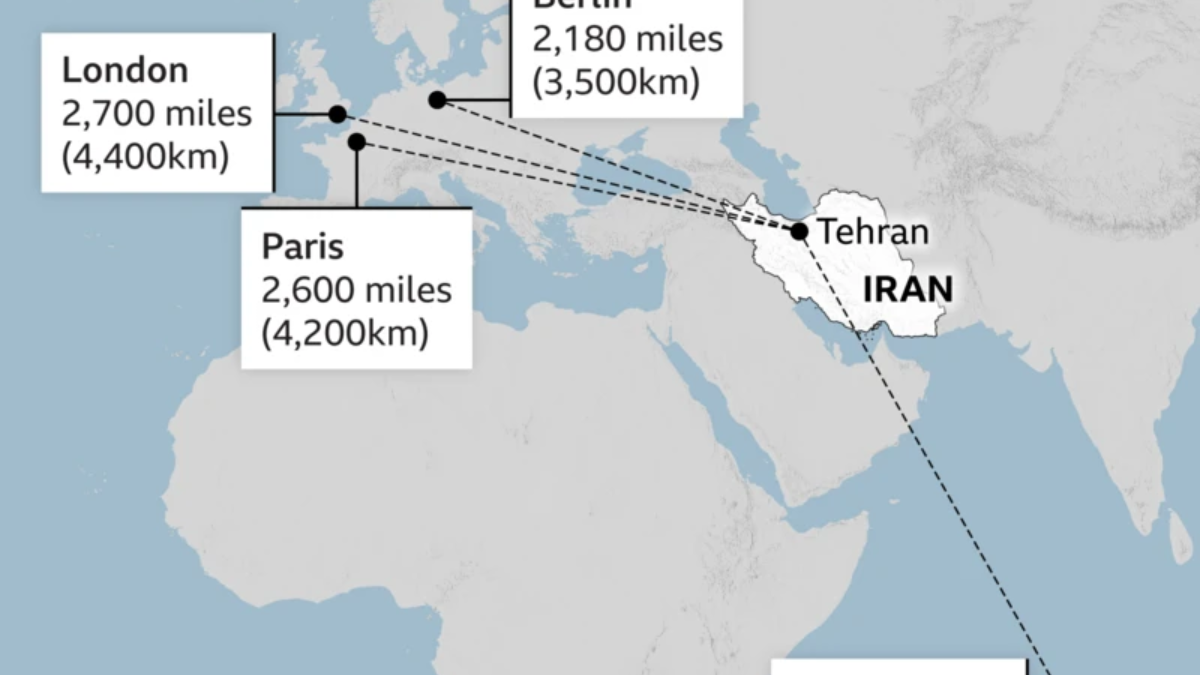
US officials and allied briefings have raised concerns by suggesting that Iran’s missile capabilities could pose a broader regional threat, though there is no confirmed public evidence that Iran can currently target London. Some assessments, including statements linked to Israel, have highlighted the potential range of Iranian missile systems, but these claims remain contested and should be treated cautiously. Reports of missile activity toward Diego Garcia are not widely confirmed in reliable public sources, and any suggestion of extended range capability is based on limited or unverified information. As a result, the situation reflects heightened geopolitical tension rather than a confirmed shift to a direct homeland security threat for Britain or Europe.
Why is London being mentioned?
The discussion around London stems from broader concerns about the theoretical range of advanced missile systems. Some estimates suggest that longer-range variants under development could extend several thousand kilometres, which in theory might place parts of Europe within reach. However, there is no verified evidence that Iran currently possesses operational systems capable of reliably striking the UK mainland. This distinction is important. Maximum range estimates do not necessarily translate into effective military capability. Factors such as accuracy, payload capacity, guidance systems and survivability significantly affect real-world threat levels, especially over long distances. As a result, references to London are better understood as part of a strategic and political narrative about deterrence rather than an indication of an imminent or credible strike capability.
Legal and security implications
For the UK, the issue requires balancing reassurance with vigilance. The government’s position has consistently been that there is no intelligence indicating an imminent threat to the UK mainland. However, broader instability in regions such as the Strait of Hormuz and risks to overseas assets highlight the need for continued monitoring and coordination with allies. From an international law perspective, the situation does not currently meet the threshold for claims related to self-defence under the United Nations Charter. Any shift toward that framework would depend on clear evidence of an imminent or actual armed threat. For now, the issue remains within the realm of precautionary security planning rather than active legal justification for escalation.
Political fallout and escalation risk
The diplomatic impact of such warnings is significant. Framing European cities as potential targets can increase political pressure for stronger responses, but it also risks escalating tensions by amplifying perceived threats. This can make de-escalation more difficult, as public and political narratives shift toward worst-case scenarios. For the UK, the key challenge is to respond proportionately. While it must remain aligned with allies and prepared for evolving risks, it also needs to avoid overstating unverified threats. At present, the available evidence suggests that the discussion of London reflects strategic signalling rather than a confirmed change in Iran’s operational capabilities.