

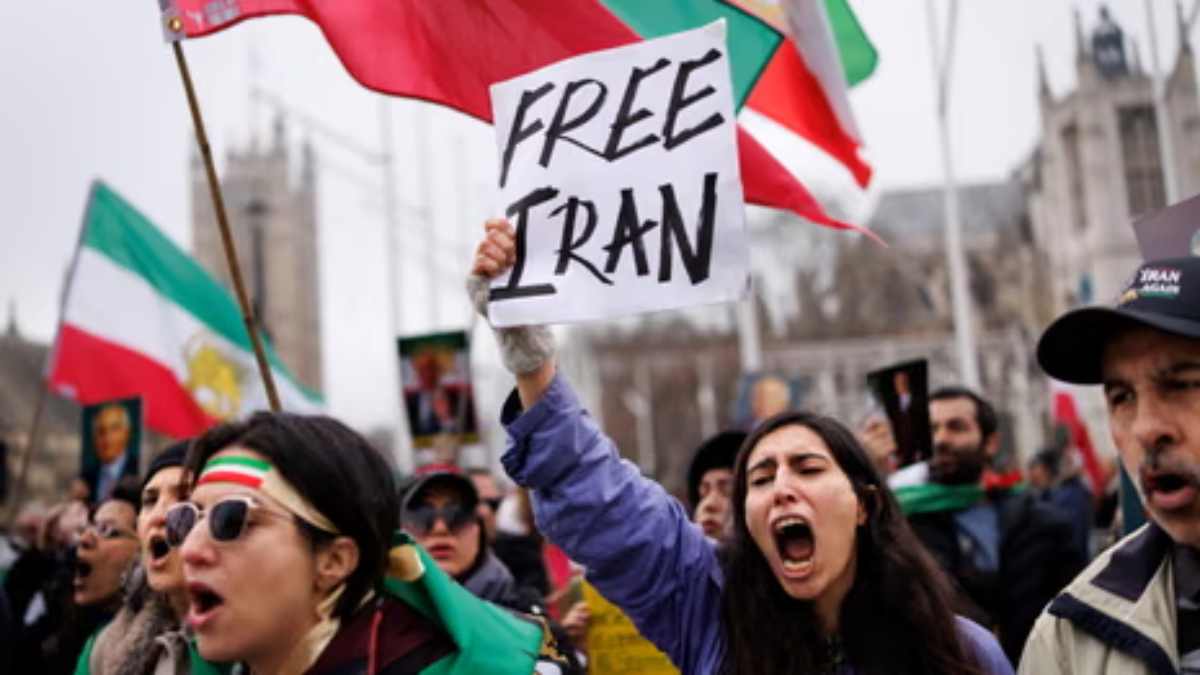
The Iranian diaspora in the UK has taken to the streets in growing numbers over the past few weeks, as the Iran war intensifies, exposing a deep and often painful split within the community over whether the conflict will ultimately bring about the liberation of Iran or deepen the country’s suffering and international isolation. In London, Manchester, and other cities with sizable Iranian British populations, demonstrators have gathered under contrasting banners: some waving the pre republic tricolour and the flags of the United States and Israel, framing the US and Israel led strikes as a necessary, if brutal, step toward ending decades of theocratic authoritarian rule, while others carry anti war placards and chant slogans condemning the bombings as imperial overreach that will only deepen repression and civilian loss of life inside Iran. The protests reflect not only political disagreement but a fractured emotional relationship with the homeland, in which nostalgia for Tehran, fear of further militarisation, and long-held anti-regime sentiment collide in a way that is now being played out in the very public space of British cities.
Two visions of liberation in the diaspora
For a significant segment of the Iranian diaspora, the war is being read through the lens of repeated domestic uprisings such as the 2022 to 2023 protests following the killing of Mahsa Amini. The decades-long pattern of state violence against dissent, leading to a view that external pressure from the United States and Israel might, however cynically motivated, create the structural break the regime has so far managed to withstand. In London and Manchester, some demonstrators have celebrated early strikes that killed or allegedly incapacitated Iran’s Supreme Leader, waving portraits of pre-revolutionary era symbols and arguing that the fall of the mullah elite, even via foreign military action, would be preferable to the ongoing cycle of mass incarceration, execution campaigns, and internet blackouts inside Iran. These voices tend to frame the current phase of the war as a potential transition moment, where the destruction of the regime’s core leadership structure could open a space for internal upheaval, diaspora activists, and civil society networks to reshape Iran toward a more pluralistic and accountable system, even if that system is not guaranteed to meet all democratic ideals. Opposing this vision are other Iranian British activists who insist that bombs and missile strikes cannot bring freedom, warning that the war risks entrenching hardline nationalism, stiffening the regime’s repression, and inviting a new era of proxy warfare and potential civil war-style fragmentation. At marches organised under banners such as Hands Off Iran, protesters, many of them Iranians but joined by British activists in solidarity, have decried the targeting of Iranian cities and energy infrastructure, arguing that civilians in Tehran, Isfahan, and other centres are already bearing the costs of Western and Israeli intervention, and that any future liberation narrative must be rooted in internal popular struggle rather than external bombardment. For this group, the spectre of a prolonged US-led air campaign or even a ground component, however framed as a blow to the regime, evokes not liberation but a familiar script of foreign powers reshaping the region according to their own strategic interests, with little regard for the complex social, ethnic, and regional fragmentation that could follow. The divide is not only strategic but moral: one side sees the war as a tragic but necessary tool to end theocratic authoritarianism, while the other sees it as a betrayal of the very people whose lives are already constrained by the regime and by global powers alike.
Legal, political and community law context in the UK
The street clashes and divergent rallies of the Iranian diaspora also raise legal and political questions under UK law about how such protests are policed, how diaspora organisations access public space, and how the line between legitimate political speech and incitement to violence is drawn. The UK’s Public Order Act 1986 and the Police, Crime, Sentencing and Courts Act 2022 define the conditions under which marches must be notified, routes approved, and counter protests or constitutional challenges managed, and in London, police have already imposed route conditions on large demonstrations, including Hands Off Iran style marches, to ensure that frequently conflicting camps do not physically collide. At the same time, social media videos and on-the-ground footage show Iranian diaspora participants in the same neighbourhoods shouting at one another, accusing each other of being brainwashed by either regime propaganda or Western imperial narratives, a dynamic that underscores the internal law-like battles over truth and loyalty that are now being conducted in the open-air forums of British streets. From a human rights and international law perspective, the UK’s legal architecture is designed to protect the right to protest, to assemble, and to express even uncomfortable or controversial views, as long as threats to public order or national security remain within the proportionality bounds defined by the European Convention on Human Rights and the UK Human Rights Act 1998. Yet the revolutionary symbolism, the celebratory tone around the death of a foreign leader, and the circulation of calls for regime change via military means, all sit on the outer edge of that legal space, prompting both community and state actors to watch closely for any slide into incitement, hate speech, or glorification of terrorism as those concepts are interpreted by UK courts and the Crown Prosecution Service. For the Iranian diaspora, this means that the debate over whether the war will liberate Iran is not only an ideological and emotional contest, but a legal and institutional one as well: it tests how the UK balances its commitment to free speech and diasporic self expression with the need to manage the risks of community fragmentation, transnational espionage tensions, and the polarising narratives that can accompany any large scale foreign war being replayed, in real time, on the streets of Finchley, Islington, and Manchester.