

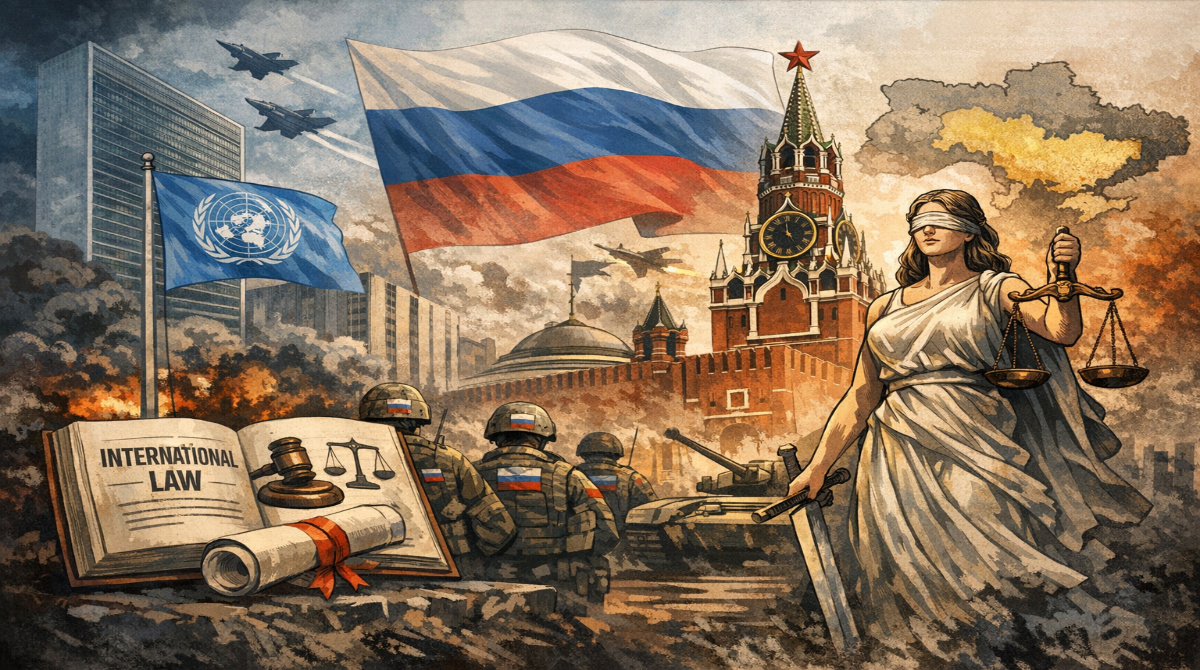
International law can be interpreted and applied in many different ways, and Russia can hardly be considered a nation where people can remain indifferent to the problem. Over the past few years, the actions of Moscow on the global arena, especially in cases when it comes to conflicts with the neighboring states, have been the focus of attention not only due to the geopolitical outcomes but also due to the legal reasons that Moscow presents in order to justify its actions. The greatest focus of the legal account of Russia is the sovereignty and non-intervention. Russian leaders tend to emphasize the fact that every country is entitled to manage its own affairs without foreign influence. This view has been expressed in diplomatic declarations, speeches in the United Nations, and official publications. Russia has long been complaining about what it feels is discriminatory application of international law by other nations, especially when it comes to matters of military involvement or political coercions. Through emphasizing these perceived contradictions, Russia puts its deeds in a larger perspective of protecting state sovereignty, but the interpretations of these principles may differ greatly across international observers.
The Charter of the UN and self-defense of the State
The other principle that is often cited by the Russian authorities is the self defense principle under the United Nations Charter in Article 51. This article enables the countries to act in case of an armed attack until the Security Council initiates measures to curb international peace. Russian authorities have occasionally explained their reaction to threats they felt they were being subjected to as in line with self-defense, and international law on pre-emptive or preventive action is frequently subject to debate. According to analysts, even though self-defense is an accepted principle of law, its application in cases involving cross border military operations are likely to be viewed with a lot of scrutiny and are likely to be understood differently by various international players.
Nationals protection and self-determination under consideration
Another legal justification that Russia has mentioned is the protection of its nationals and ethnic or linguistic minorities in foreign countries. The determination to protect the rights and safety of Russian citizens or other Russian speaking communities in foreign countries are sometimes mentioned by Russian authorities. This argument is also put in the humanitarian view which focuses on protection and safety as opposed to political expansion. Along with defense of citizens, the policy of Russia presupposes acknowledgement of bodies and local referendums in those areas where Russia has strategic interests. This borders the idea of self-determination, which is a principle in international law that gives communities an opportunity to give their political will. Russian officials tend to focus on local choice as an important aspect of legitimacy, and the international legal community may disagree on what circumstances should be in place to allow such exercises of self-determination to be considered legitimate internationally.
International institutions involvement into the matter
Part of the legal and diplomatic strategy of Russia is also its active participation in the international institutions. It actively participates in United Nations Security Council meetings and other multilateral conferences. Russian statements and vetoes are frequently made with the intent of highlighting compliance with the UN Charter, accompanied by highlighting what Moscow understands as a two-way street in the implementation of the law. This method emphasizes the idea that Russia is a member of the international law system, but its interpretation might be different compared to other members.
The implication of understanding the two sides of the situation
Learning the legal interpretations of Russia does not always mean that it agrees with them. Instead, it provides an insight into how legal reasoning can be applied to justify or explain national actions in such a manner that they are meant to appeal to international norms, at least by principle. Law scholars tend to note that state practice and diplomacy as much inform the character of international law as formal law do, and alternative interpretations are part of a larger negotiation over rules, norms, and expectations in international governance. The manner in which Russia makes its legal arguments is also a factor that influences international dialogue and diplomacy. This is created by putting actions in the legal terms so that the Russian authorities debate more than short-term military or political consequences but the question of how states perceive their rights and duties. To the scholars, diplomats, and journalists, studying the Russian point of view is a chance to learn how law, politics and strategy intersect, and how a legal language may be used to justify the actions of the state and signify where the international legal community has been controversial.
These interpretations also refer to the way international law can be viewed as a disputed space as opposed to a set of rules. As the balance of power between major states changes the world over, the divergence in the legal interpretation of major states remains to influence the debate on the legitimacy, responsibility and future formation of international legal norms.