A new analysis reveals a sharp rise in discriminatory trade measures, undermining the predictability of global commerce and hitting developing countries hardest, as nations increasingly deploy tariffs, investment screens, and tech curbs tied to industrial policies, security, and geopolitics. The report stresses that reforming World Trade Organization (WTO) rules is vital to restore market stability, boost export diversification, and support sustainable growth amid volatile trade flows.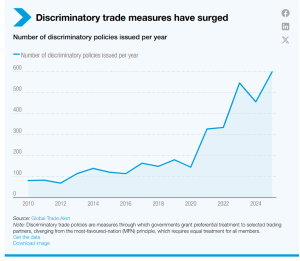
Discriminatory policies have accelerated dramatically since 2010, with annual issuances climbing from low dozens to peaks exceeding 500 by 2024, diverging from the most-favoured-nation principle that demands equal treatment among trading partners. This surge, tracked by independent monitors, exposes vulnerabilities in export-dependent economies, where sudden barriers disrupt supply chains and inflate costs for machinery, energy, and inputs critical to industrialization. Developing nations, often reliant on narrow export bases, face amplified shocks from such volatility. 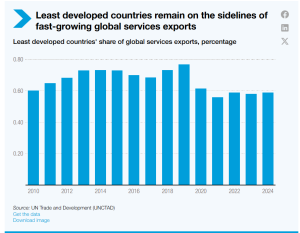
South-south trade booms amid global challenges
Trade between developing countries South-South flows has exploded from $500 billion in 1995 to $6.8 trillion in 2025, now comprising over a quarter of world trade and outpacing North-bound exports from the South. This expansion underscores the multilateral system’s role in fueling investment, tech transfer, and jobs, especially for smaller economies where domestic markets fall short. Yet integration barriers persist, with least developed countries (LDCs) holding just 1.1% of global merchandise exports in 2024 stagnant near 1% since 2010 and well below the 2030 target of 2%, despite preferential schemes.
WTO reforms must prioritize tools for market entry, value chain ascent, and export variety to amplify these gains, the update argues. South-South dynamics now see 57% of developing-country exports staying within the group, driven by Asian hubs but expanding in Africa and Latin America, offering a buffer against faltering Northern demand.
Dispute system paralysis slows trade justice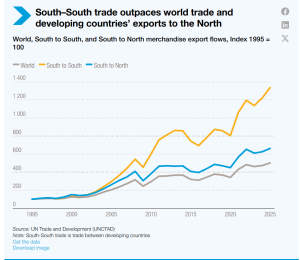
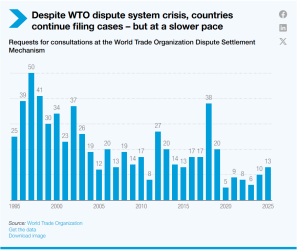
The WTO’s dispute mechanism, launched in 1995, has handled 644 cases with 378 panels formed, enabling smaller players to enforce rules against larger foes. But Appellate Body gridlock—due to blocked judge appointments—has slashed new consultations from 19 yearly (2010-2019) to 8.5 (2020-2025), eroding binding commitments. Reviving this system is crucial for equitable defense of trade rights, particularly for vulnerable exporters facing discriminatory hikes.
Services lag highlights inclusion gaps
Evolving trade demands rules for services, digital, and green shifts, where LDCs capture under 1% of global services exports—growing at 3% annually (2014-2024) versus 5.3% worldwide. Multilateral clarity on digital trade, finance, and professions, plus bolstered special and differential treatment, would unlock participation.
With WTO talks advancing, the analysis centers development in reforms: full dispute functionality, non-discrimination safeguards, and predictable access to sustain inclusive trade as a growth engine. Failure risks deeper fragmentation, while targeted changes could fortify resilience for decades.