

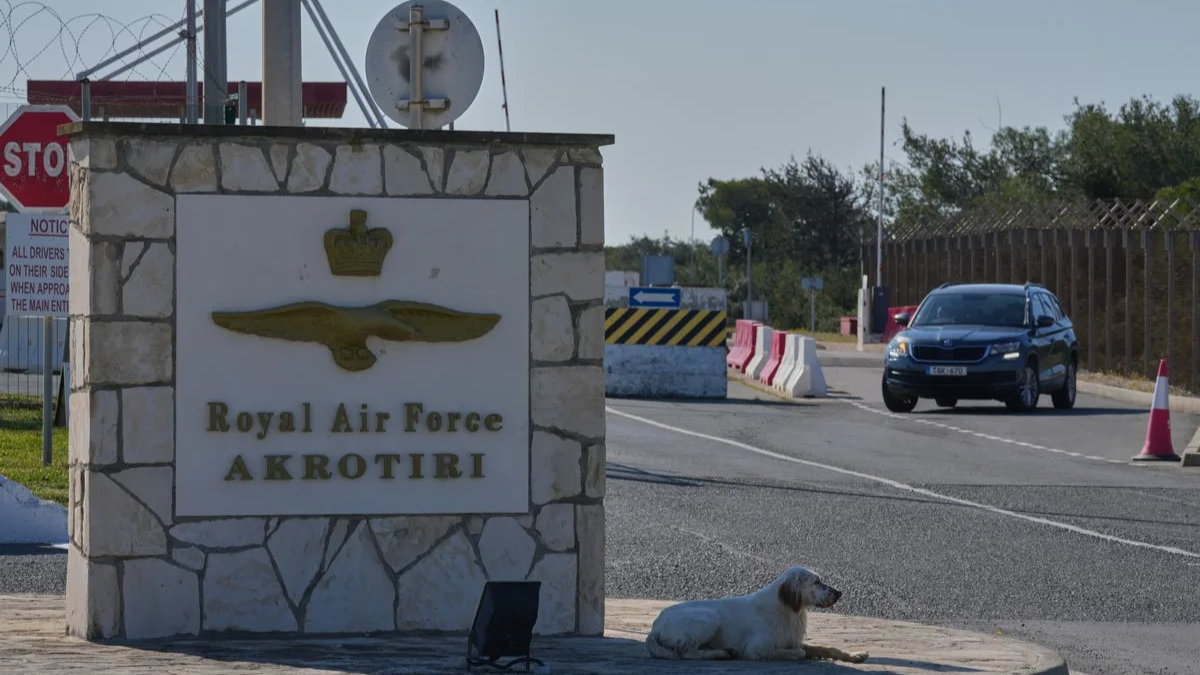
Cyprus is expected to seek a new security deal with the UK after concerns linked to the role of RAF Akrotiri have highlighted how exposed the island can become when British military assets are drawn into a wider regional conflict. While there is no confirmed public evidence of a direct strike on the base, the situation has sharpened long-standing concerns in Nicosia that the sovereign base areas are not simply UK military installations, but potential strategic flashpoints that can place Cyprus in the firing line without giving the Republic of Cyprus full control over the risks. What was once treated as a stable and largely administrative arrangement now looks increasingly fragile in a Middle East where airbases, missile threats and maritime disruption are feeding into one another.
Strategic pressure on Cyprus
The significance of RAF Akrotiri goes well beyond the physical impact of any single incident. It is one of Britain’s most important overseas military hubs, used for intelligence, surveillance, air operations and rapid regional response, and its presence on Cypriot soil means that any escalation in Iran-related tensions can quickly spill into Cypriot security calculations. When a base of that scale is perceived to be at risk, Cyprus has reason to ask whether its own airspace, emergency services and civilian infrastructure are being exposed to a conflict over which it has very limited influence. This is where the politics become delicate. Cyprus is not asking for the bases to disappear, because it understands their strategic importance and the economic and diplomatic relationship with the UK. But it is likely to argue that if the island hosts the military risk, it must also receive stronger guarantees in return. That means more explicit commitments on air defence, crisis response, consultation and information sharing, especially if the bases are to be used for operations linked to Iran-related tensions. The situation has therefore turned a long-running sovereignty issue into a practical security question, one that Cyprus can now raise with greater urgency. There is also a broader constitutional problem. The sovereign base areas are a highly unusual legal arrangement, remaining under UK sovereignty while being embedded within Cypriot territory and connected to the island’s transport, airspace and civilian life. That means any new security deal has to balance military necessity with political legitimacy. Cyprus may not be able to change the basic status of the bases, but it can demand clearer rules on emergency coordination, compensation, civil protection and the duty of the UK to consult in times of crisis.
Why a new deal is likely
The current arrangement was not designed for a period in which missile threats, drone attacks and regional spillover have become routine concerns. Akrotiri was built for strategic reach, but the present security environment has increased its exposure to risk as well as its strategic value. If Cyprus is expected to host a base that could attract retaliation, it will want stronger guarantees that the UK will help manage the consequences, not simply operate from the island when it is convenient. A new deal is therefore likely to focus on practical safeguards rather than a dramatic constitutional overhaul. That could include improved early warning systems, clearer protocols for intercepting incoming threats, better protection for local communities near the base and more direct crisis communication between London and Nicosia. Cyprus may also seek some form of reassurance that the island will not be left to absorb the political and security fallout alone if the bases are targeted. In legal terms, this is less about ending UK sovereignty and more about redefining responsibility in a more volatile security environment. The UK, for its part, will want to preserve full operational flexibility at Akrotiri. It will not want arrangements that slow military response times or limit use of the base during emergencies. But London also has a strong incentive to avoid a rift with Cyprus, because the bases depend on continued political acceptance from the host state and because any appearance of disregard for Cypriot concerns would weaken the long-term sustainability of the arrangement.
Wider implications
The situation around Akrotiri reflects a broader pattern in regional tensions: conflict risks are no longer confined to immediate battlefields, but can extend into allied territory, energy routes and overseas installations. That makes Cyprus a test case for how smaller host states can negotiate with major powers when strategic military assets become potential targets. The island is not simply reacting to a single incident. It is confronting the reality that its geographic position and the UK’s military posture have combined to increase its exposure to regional instability. If a new security deal is reached, it will probably not change the fundamentals of UK sovereignty over the bases. But it is likely to tighten consultation, improve coordination and require the UK to recognise that Akrotiri carries obligations as well as advantages. For Cyprus, that may be the central legal and political lesson: if British bases are going to remain on the island and be used in a volatile regional context, then the island must receive more than reassurance. It must receive a structure that recognises its vulnerability and shares the burden more fairly.