

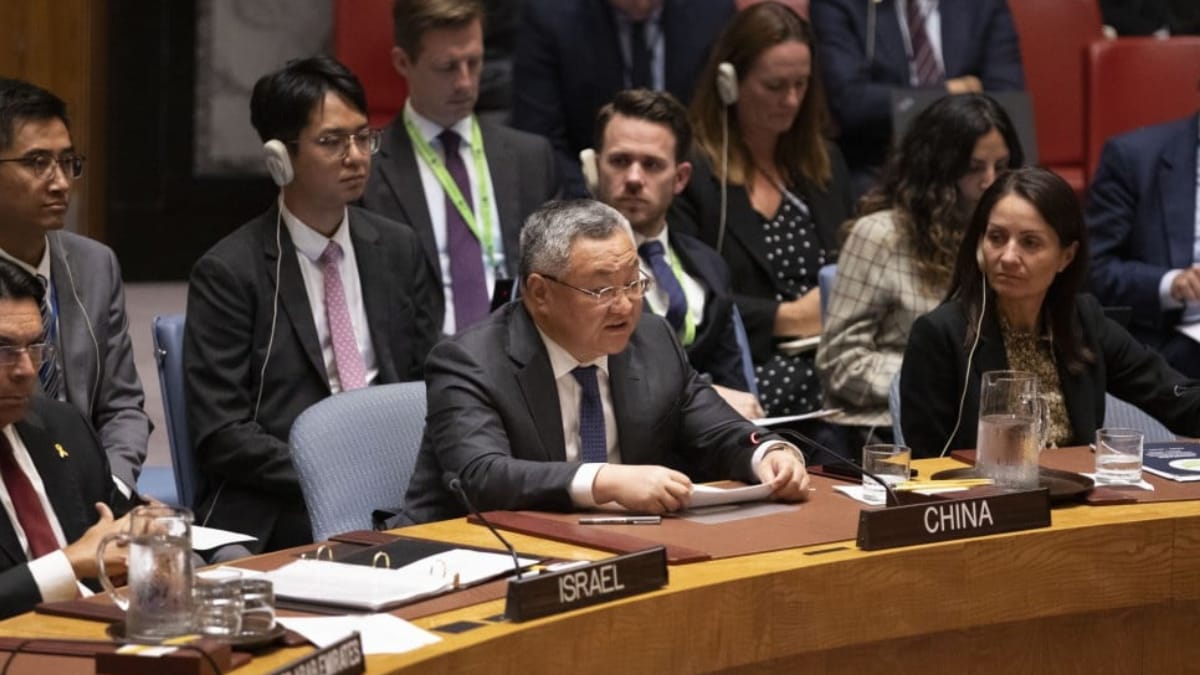
China’s forceful diplomatic response to the reported military strikes carried out by the United States and Israel against Iran represents far more than routine geopolitical commentary. It is a calculated invocation of core principles of the post 1945 international legal order, and it situates Beijing squarely within the normative architecture of the United Nations Charter at a moment of heightened volatility in the Middle East. By expressing grave concern, demanding an immediate cessation of military actions, and emphasising respect for Iran’s national sovereignty, security, and territorial integrity, China has framed the episode as a potential breach of foundational rules governing the lawful use of force in international relations.
At the heart of the matter lies Article 2, paragraph 4 of the Charter of the United Nations, which prohibits the threat or use of force against the territorial integrity or political independence of any state. This provision is widely recognised as a cornerstone of contemporary international law and is considered reflective of customary international law binding on all states, including the United States, Israel, Iran, and China. The prohibition admits of only two established exceptions: individual or collective self-defence under Article 51 in response to an armed attack, and action authorised by the United Nations Security Council under Chapter VII to maintain or restore international peace and security. Any military strike that cannot be justified within these narrow confines prima facie engages state responsibility for an internationally wrongful act.
China’s emphasis on Iran’s sovereignty and territorial integrity is legally significant. Sovereignty in this context is not a rhetorical abstraction but a concrete legal entitlement to exclusive authority over territory and domestic affairs. The International Court of Justice, in cases such as Military and Paramilitary Activities in and against Nicaragua and Armed Activities on the Territory of the Congo, has repeatedly affirmed that the prohibition on the use of force and the principle of non-intervention are interlocking norms that protect the structural stability of the international system. If the reported strikes were conducted without Security Council authorisation and absent a demonstrable armed attack triggering Article 51, then their legality would be subject to stringent scrutiny under both treaty and customary law.
Any claim by the United States or Israel that the strikes were undertaken in self-defence would require a careful examination of necessity and proportionality, the twin conditions embedded in the customary understanding of Article 51 and reaffirmed in jurisprudence and state practice. Necessity demands that force be used only when no other means are available to repel or prevent an armed attack. Proportionality requires that the scale, scope, and duration of the defensive response be commensurate with the gravity of the initial attack. Preemptive or preventive uses of force, especially in relation to alleged future threats such as nuclear proliferation, remain deeply contested in international law. The 2003 Iraq war and subsequent debates on anticipatory self defence underscore the fragility of legal consensus in this domain. China’s call for the resumption of dialogue and negotiation implicitly rejects expansive interpretations of self defence that risk normalising unilateral force.
From a Security Council perspective, the dynamics are equally complex. As a permanent member of the Council, China wields veto power and plays a pivotal role in shaping collective responses to crises. Its statement signals that it may resist any attempt to retrospectively legitimise unilateral military action through Council endorsement. The absence of prior Council authorisation would place the burden squarely on the acting states to justify their conduct under Article 51, including the obligation to report measures taken in self defence to the Council. Failure to comply with the reporting requirement has been criticised in past conflicts as indicative of weak legal grounding.
The demand for immediate cessation of military actions and the resumption of dialogue resonates with Chapter VI of the Charter, which obliges parties to any dispute likely to endanger international peace and security to seek a solution by peaceful means. Negotiation, mediation, conciliation and arbitration are not optional diplomatic courtesies but integral components of the legal architecture designed to prevent escalation. In a context where miscalculation could trigger wider regional conflagration involving multiple state and non state actors, the call for de escalation carries both legal and pragmatic weight.
In real time strategic terms, the calculus of escalation control is central. Military exchanges between the United States, Israel and Iran carry the risk of spill over into maritime security in the Gulf, energy markets and broader regional alignments. International law serves as both a normative guide and a practical instrument for managing such risks. Clear articulation of legal thresholds, reporting obligations and proportionality standards can shape state behaviour even in periods of acute tension. China’s insistence on dialogue reflects an understanding that once force dynamics spiral, legal discourse often yields to faits accomplish
Ultimately, the episode underscores the enduring tension between power politics and legal constraint. The prohibition on the use of force remains one of the most ambitious normative achievements of the twentieth century, yet its resilience depends on continual reaffirmation by states, especially major powers. By calling for respect for Iran’s sovereignty and an end to military action, China has positioned itself as a defender of the Charter order. Whether that defence is perceived as principled consistency or strategic opportunism will be debated in diplomatic and academic circles alike. What is beyond dispute is that the legal stakes are immense, and that any deviation from the established framework governing the use of force reverberates far beyond the immediate theatre of operations, shaping the trajectory of international peace and security for years to come.