

The unfolding crisis around the Strait of Hormuz has done far more than disrupt oil shipments. It has triggered a structural reconfiguration of global maritime trade, rerouting cargo flows, recalibrating freight economics, and redistributing port profitability in ways that are both immediate and potentially enduring. What appears, on the surface, to be a regional security flashpoint has, in reality, evolved into a global logistics realignment.
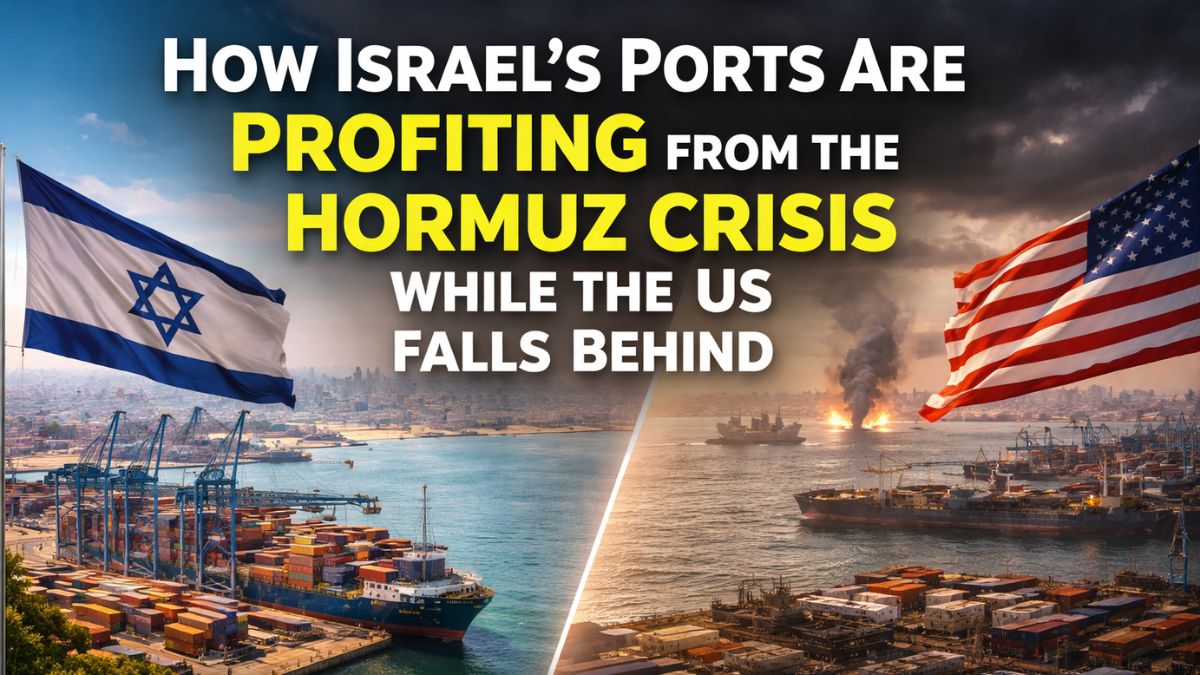
This transformation is diverging: Israel’s ports, particularly the Port of Haifa and Port of Ashdod, are seeing a surge in throughput, pricing power, and geopolitical relevance. Meanwhile, the United States, despite commanding naval supremacy and exerting considerable influence over maritime security in the Gulf, is witnessing stagnation across its port ecosystem, compounded by inefficiencies and a failure to capture redirected trade flows. This divergence is not coincidental. It is rooted in geography, strategy, and the evolving logic of risk-priced shipping.
The Strait of Hormuz remains one of the most critical arteries of global commerce. Roughly one-fifth to one-quarter of global oil product consumption passes through this narrow corridor, alongside a substantial share of liquefied natural gas, petrochemicals, and fertilisers. Any disruption here reverberates across continents, affecting not only energy prices but the cost structures of manufacturing, agriculture, and logistics.
The 2026 escalation sharply curtailed tanker movements, with shipping volumes collapsing dramatically at the height of the crisis. Even in the current phase of partial reopening, the strait functions under constrained conditions. Vessel traffic remains significantly below pre crisis norms, insurance premiums for transiting ships have multiplied several times over, and naval oversight has introduced delays that disrupt tightly calibrated global supply chains. The result is a shipping environment no longer governed by efficiency alone. Instead, it is dictated by risk, insurance feasibility, and geopolitical predictability. In such an environment, the shortest route is no longer the optimal route.
Israel’s logistical advantage
Israel’s maritime advantage in this crisis stems from its unique positioning at the intersection of emerging alternative trade corridors. Unlike Gulf based ports, it lies outside the immediate risk envelope of Hormuz. Unlike distant transatlantic hubs, it remains proximate to both Asian manufacturing centres and European consumption markets. As shipping lines seek to avoid the uncertainties of the Gulf, cargo flows are increasingly being rerouted through the Red Sea into the Mediterranean. This shift has revived and accelerated interest in the India Middle East Europe corridor, often abbreviated as IMEC, which envisions a multi modal trade route connecting South Asia to Europe via the Arabian Peninsula and the eastern Mediterranean.
Within this framework, Israel functions as a natural terminal hub. Cargo arriving from the Red Sea can be offloaded, processed, and redirected into European markets with reduced exposure to geopolitical volatility. This positioning enables Israeli ports to capture not only higher volumes but also premium pricing. In a risk sensitive market, reliability commands a price, and Israel is currently able to offer a comparatively stable logistical environment. Moreover, the economics of crisis amplify these advantages. Shipping companies are willing to pay higher port charges and accept marginally longer routes in exchange for reduced uncertainty. Israeli ports, benefiting from this recalibration, are witnessing improved utilisation rates, faster turnaround cycles relative to congested alternatives, and stronger bargaining power in negotiating long term shipping contracts.
The American paradox
The United States occupies a position of undeniable strategic strength. Its naval presence in and around the Gulf underpins the security architecture of global shipping. It has the capacity to escort vessels, enforce blockades, and influence the operational dynamics of the Strait of Hormuz. Yet this strategic dominance has not translated into commercial gain for its ports. The reasons are structural and multifaceted. First, the American approach has centred on containment and deterrence rather than logistical redirection. While naval operations have mitigated certain risks, they have not created alternative trade pathways that channel cargo towards US ports. Instead, shipping lines have independently rerouted flows towards more predictable corridors, many of which converge in the Mediterranean rather than the Atlantic. Second, longstanding inefficiencies within US port infrastructure have limited its ability to capitalise on global disruptions. Labour disputes, congestion issues, and slower turnaround times have eroded competitiveness. In a crisis environment where predictability is paramount, these inefficiencies become decisive disadvantages. Shipping lines prioritise ports that can guarantee swift and reliable handling over those that offer scale but lack operational consistency.
Third, the United States’ relative energy self sufficiency reduces its exposure to Hormuz driven disruptions. While this insulates the domestic economy from certain shocks, it also diminishes the incentive to reconfigure trade flows through US ports. Unlike Israel, which can position itself as a critical transit hub, the US functions largely as an endpoint market with limited relevance to the rerouted Asia Europe corridor. Finally, financial market behaviour underscores this paradox. American energy and chemical sectors have exhibited sensitivity to fluctuations in Hormuz accessibility, indicating that their gains are tied more to price volatility than to increased logistical throughput. In essence, the United States benefits from disruption as a producer, but not as a maritime intermediary.
The re-routing of global shipping networks
The current crisis has catalysed three interrelated transformations in global shipping. Volume redistribution is the most immediate. Traffic through the Gulf has declined sharply, while the Red Sea and Mediterranean corridors have experienced a corresponding increase. Israeli ports, strategically positioned along these routes, are absorbing a portion of this redirected flow. Cost structures have also evolved. Freight rates now incorporate war risk premiums, elevated insurance costs, and the financial impact of delays. These factors have narrowed the cost differential between traditional and alternative routes, making previously secondary corridors economically viable. Perhaps most significantly, routing logic has changed. Shipping companies are no longer optimising purely for distance or fuel efficiency. Instead, they are prioritising political stability, insurance feasibility, and the predictability of naval protection. This shift favours mid route hubs that offer flexibility and reliability over endpoint ports that lack integration into emerging corridors.
New maritime economy and the risk
A defining feature of the current moment is the rise of risk arbitrage in shipping. Operators are actively reallocating routes to minimise exposure to geopolitical volatility while maximising operational certainty. This involves avoiding high risk chokepoints, even at the cost of longer transit times, and leveraging ports that can guarantee continuity. Israel has emerged as a key beneficiary of this dynamic. Its ports offer a combination of geographic proximity to major trade lanes, relative insulation from direct conflict, and integration into evolving corridor strategies. This enables them to function not merely as national infrastructure assets but as nodes in a broader network of risk managed trade. The United States, by contrast, remains peripheral to this arbitrage. Its ports are not central to the alternative routes being developed, and its strategic focus on security does not directly translate into logistical monetisation. The result is a divergence between military influence and commercial benefit.
Temporary or permanent
Whether this divergence persists depends on the duration and intensity of instability in the Gulf. In the short term, Israel is likely to continue benefiting from elevated volumes and pricing power. In the medium term, shipping lines may formalise new routing strategies, embedding Mediterranean hubs more deeply into global supply chains. Over the longer term, sustained instability could entrench these changes, transforming Israel into a permanent gateway between Asia and Europe. However, this outcome is not predetermined. A durable stabilisation of the Strait of Hormuz could restore traditional routing patterns, reducing the relative advantage currently enjoyed by alternative corridors. Conversely, further escalation would accelerate the shift away from the Gulf, amplifying the role of ports that can operate outside its shadow.
The Hormuz crisis underscores a fundamental shift in the nature of maritime power. Control over sea lanes, while still critical, no longer guarantees economic advantage. What matters increasingly is the ability to integrate into and shape trade routes that are resilient to disruption. Israel’s ports exemplify this new paradigm. By aligning geography with emerging corridor strategies, they have positioned themselves to capture value from a rapidly evolving shipping landscape. The United States, despite its unmatched naval capabilities, illustrates the limits of strategic control in the absence of logistical integration. In a world where risk is the defining variable, the winners are not those who dominate the oceans, but those who can reconfigure them into reliable and profitable pathways. At present, the balance of advantage lies firmly with Israel.