

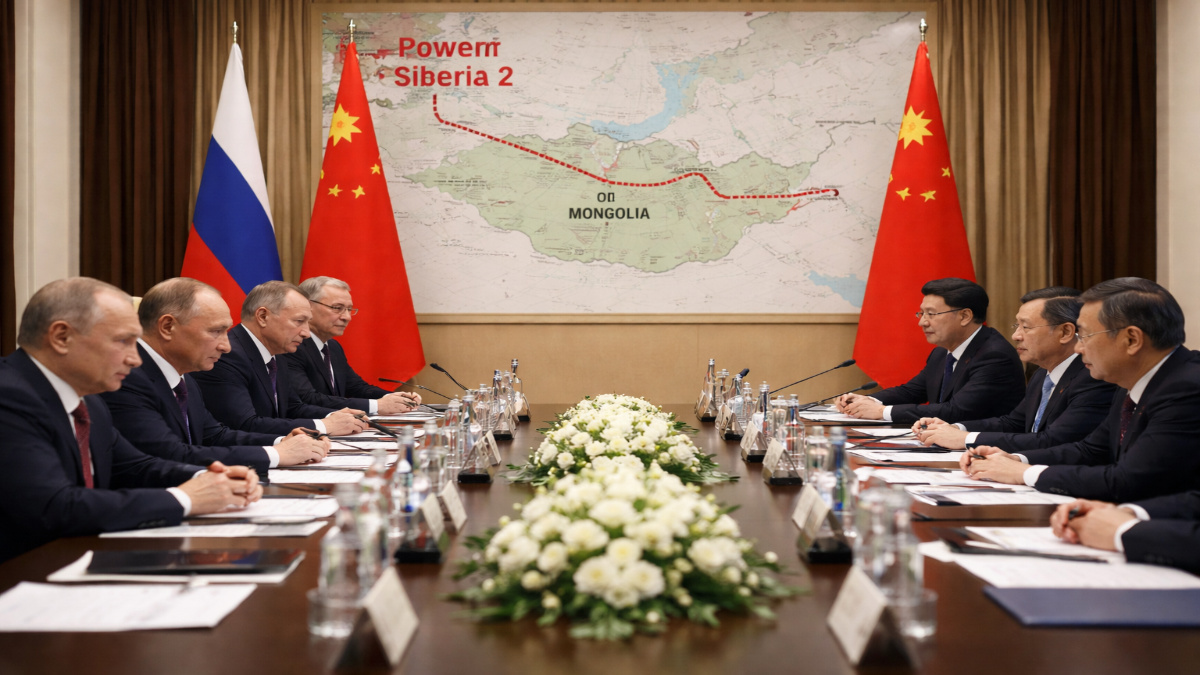
The dynamic energy policy in China has again raised the eyebrows over its increased collaboration with Russia especially in the area of natural gas infrastructure. There is recent news out of Beijing that an issue that has been long talked about in Power of Siberia 2 gas pipeline might be actually taking a step in the right direction, though there are still significant doubts about its ultimate design and execution. This development, which follows, is happening when geopolitical tensions and instabilities in world energy markets, particularly those related to the current crisis involving Iran are compelling world economies to re-evaluate their long-term energy sources and the diversification of their fueling sources.
The five-year plan of China, the 2026-2030 draft of which was published as part of the annual meeting of the legislature of the country in Beijing, also mentioned the expansion of natural-gas networks between China and Russia. In the development blueprint, there was a language that stated that China would make preparatory work related to the central route of China-Russia natural gas pipeline within the next five years. The phrase soon drew the notice of energy analysts and other market observers, with many of them interpreting the reference as referring to the long-awaited Power of Siberia 2 pipeline project. The pipeline was traditionally considered to be the symbolic and strategic element of relationships between China and Russia as it is not only the economic cooperation but also the possibility to change the character of energy relations in the region.
Even though, the draft plan included both projects related to two natural gas pipelines between China and Russia, the central route was the center of discussion as analysts feel that the route includes Power of Siberia 2 that would connect all of Mongolia until it reaches north China. Through its construction, should it ever be constructed, the pipeline would become one of the largest energy infrastructural ties between the two nations, and an important addition to the Chinese web of natural gas imports. Simultaneously, the project would offer Russia another significant export avenue of its huge natural gas reserves.
The suggested pipeline is an enormous project. It is located over a distance of about 2,600 kilometres and has been estimated at about US 13.6 billion and has an estimated capacity of about 50 billion cubic metres of natural gas annually. This would make it an important element of the energy provision system in China once it is completed. Nevertheless, even with the scale of the project and its strategic role, it has lagged behind at a slow pace. The pipeline discussions can be traced back to 2006 and during the years the project has been delayed several times because of the unanswered commercial and political issues.
The move by China to establish the preparatory language as part of its new five-year development plan thus created a controversy whether the project was experiencing momentum or not. The wording is interpreted by some analysts as a preparation of the groundwork by Beijing towards a construction that will happen one day in particular with the world energy situation becoming all the more unstable. But the document itself did not much detail. It failed to offer particular deadlines, dates of construction, and concluded deals between governments and companies in question. Due to this detail, several professionals warn that the reference is more to be taken as an indicator of interest than a guarantee that the construction would start soon.
Two key state-owned energy companies Gazprom, the state-owned gas powerhouse of Russia, and China National Petroleum Corporation (CNPC) which is one of the largest energy companies in China, are spearheading the project. These companies are key stakeholders in the negotiation of the manner in which the pipeline was to be funded, built and managed. Aleksei Chigadaev, an associate fellow at the New Eurasian Strategies Centre argues that there are still some key issues that will have to be addressed before the pipeline work can commence. Some of the key questions will include the ownership interests that Gazprom and CNPC will have in the project. One important step in progressing the project is to determine the way the responsibilities and benefits will be split between the two companies.
One more problem that is not decided is financial. The infrastructure is that large that it demands immense investment and the construction must be negotiated on how the cost will be financed and the investor. Financing decisions will eventually determine the economic viability of the project, and the pace at which the project is likely to be rolled out. According to Chigadaev, the pipeline was to be a long and capital-intensive venture and take several years to be finalized after agreements are made.
Besides financing and ownership issues, the cost of the gas to be pumped on the pipeline is also a main concern of the negotiation. The pricing formula between Russia and China needs to be settled on in the manner that will please both. The business base of the project will be unstable until such a setup has been accomplished. Negotiations have been historically complicated in terms of pricing in the energy deals between the two nations and arriving at a formula that can be acceptable by both parties might take a lot of discussion.
One of the main peculiarities of the offered pipeline is its passage to Mongolia, which would be the country of transiting between the gas fields of Russia and Chinese markets. The Mongolian part of the project is linked with Soyuz Vostok gas pipeline that would constitute the transit line over the Mongolian land. Since the pipeline will traverse three countries, Russia and China will not be the only ones involved in the discussions, and another dimension of diplomatic and logistical alignment of the project will be introduced.
In the first half of the year, Gongor Damdinnyam, a Minister of Industry and Mineral Resources of Mongolia, was in China and had a meeting with representatives of CNPC on cooperation in the field of a Russian gas pipeline through Mongolia. The visit also saw both parties commit to work harder on the project even though the pipeline was not mentioned directly in the speeches. The debates were popularly perceived to be related to the initiative of the Power of Siberia 2.
These negotiations came after a previous diplomatic move had been taken in September wherein leaders of China, Russia, and Mongolia signed a legally binding memorandum that had specifications on the building of a gas pipeline between the three nations. The deal covered not only the Power of Siberia 2 pipeline, but also Soyuz Vostok transit pipeline that would go through the Mongolian territory. The agreements emphasize the value of trilateral cooperation in terms of the project success.
Nevertheless, the talks concerning the Mongolian segment can not be disconnected of the larger talks on the entire pipeline network. As Munkhnaran Bayarlkhagva, a former member of the National Security Council at the Mongolian government, the resolution of the construction of the pipeline in the country is conditional on the conclusion of the negotiations regarding the entire relationship between Russia and China. This is because only after the two key partners reach contracts on financing, ownership, and the price of gas, it is possible to consider the genre of negotiations about the transit route in a more definite way.
Bayarlkhagva also implied that the latest events can be seen to mean that the manner in which the Mongolian portion of the pipeline is going to be run will change. Previously, Gazprom in Russia had been thought to favour having exclusive control over the Mongolian part of the project. Nevertheless, the recent events can be taken as the indication that Gazprom is ready to share the responsibilities and expenses with Chinese partners. This might include the participation of Chinese in the construction, engineering, and also in funding the transit pipeline. Provided that, this collaborative strategy would be able to share the financial cost and the advantages of the project between the countries that are involved.
Although these are indications of a potential development, Bayarlkhagva pointed out that one of the most important questions is still to be answered; the cost of the gas that China would buy over the pipeline by Russia. The economic foundation of the project is still unclear unless there is a clear consensus on the price. However, he proposed the latest events could be the sign that the negotiation process is gaining momentum and that the final deal could be underway.
The renewed interest in the development of pipeline is surrounded by intense turbulence in the global energy markets too. Iran war as a conflict has broken supply trends and sparked the issue of stability in energy producing areas. These events have demonstrated that the geopolitical events and conflicts make international energy trade vulnerable. In the case of China, the supply of natural gas that is reliable and diversified has become a more significant strategic goal.
A possible inclusion of a new pipeline of Russia is likely to enhance the energy security of China by availing an alternative source of steady supply. Once finished, the Power of Siberia 2 pipeline would pass immense amounts of natural gas straight through Russian fields to north China and eliminate the need to use other supply channels that may be influenced by geopolitical tensions or fluctuations in the market.
Meanwhile, the project would be the significant extension of the Russian gas export network to the markets in Asia. In the case of Russia, the enhancement of energy relations with China will provide the country with a possibility to diversify export opportunities and enhance economic collaboration between the two nations.
However, even in the case when a negotiations eventually lead to a final agreement, the period during which it will be completed will be lengthy. The construction of a pipeline that crosses several countries and over thousands of kilometres demands a lot of engineering, planning of it, and logistics. Building in itself may require a number of years after the project is started officially.
To date the inclusion of the pipeline language in the new five year plan adopted by China is more of a message of strategic intent. It shows the further interest of Beijing in enhancing the energy relations with Russia and the significance of natural gas in long-term energy planning in China. Nevertheless, the lack of specific agreements between Beijing and Moscow demonstrates that the negotiations are still in progress and that the project is at the stage of planning.
Vast energy infrastructure projects are not known to go fast especially where they entail more than one country and sophisticated business deals. Power of Siberia 2 pipeline has already been discussed almost 20 years, and its actualization will become possible after the rest of the economic and political issues are solved.
Despite this, there are those analysts who view the recent developments as an indication that the project might be currently gaining momentum. In case China continues with preparatory work and OD, it may mean that the talks among the involved countries are heading to the final deal. The scenario, as postulated by Bayarlkhagva, is a time when the ice has broken and this is an indication that something might be coming after years of doubt.
The final decision as to whether the pipeline is born or not will be determined by the success of subsequent negotiations between governments, energy firms and transit partners. Until the results of these talks can lead to tangible contracts on financing, ownership, and pricing, the Power of Siberia 2 pipeline will continue to be a project that is characterized by possibilities, but not reality. However, its role in development planning in China suggests the strategic significance of long-term energy relations between China and Russia in a world where geopolitical crises are becoming major dictators of the energy environment throughout the world.