
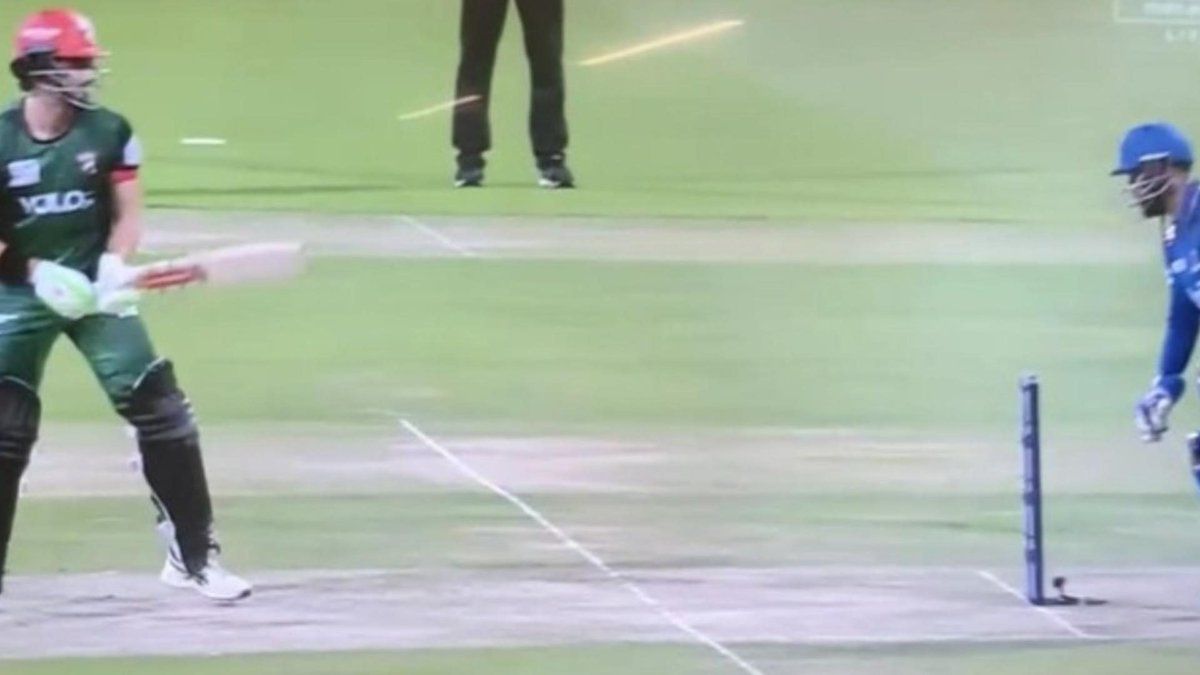
Desert Vipers’ one-run win over MI Emirates in the ILT20 on Tuesday produced one of the strangest passages of play in recent T20 cricket — a declined stumping by Nicholas Pooran followed immediately by Max Holden being retired out. The sequence sparked social-media speculation, with some fans questioning whether MI Emirates intentionally avoided dismissing Holden.
Here is what actually happened — and why both sides of the debate look very different when the full context is understood.
What the incident was
In the 16th over, Holden charged down the track and was miles out of his crease after missing Rashid Khan’s delivery. Pooran collected the ball cleanly but made no attempt to stump him. The umpire called it a wide. On the very next ball, Holden missed again — and Desert Vipers retired him out immediately for tactical reasons.
The moment looked bizarre, especially because MI Emirates had just lost a review on the previous delivery trying to dismiss Holden caught behind.
Side 1: Why some fans felt the moment looked suspicious
Several social-media users questioned the decision because:
-
Holden was yards out — Pooran could have removed the bails easily.
-
MI Emirates were defending, so declining a free wicket looked illogical.
-
The retirement-out call came immediately after, making the sequence appear coordinated.
-
The match ended as a one-run result, so every moment felt magnified in hindsight.
This combination gave rise to conspiracy-style chatter online that MI Emirates might have avoided the stumping intentionally.
Side 2: Why there is no evidence of fixing – and the cricketing explanation
When analysed with match context, Pooran’s decision becomes understandable:
1. Pooran expected a wide
As Holden had run down the pitch and the ball was clearly outside the line, Pooran focused on appealing for a wide, not a stumping. Wicketkeepers often prioritise the wide call if the batter is attempting a charge.
2. Momentum and field awareness
Players sometimes react instinctively based on rhythm — not every missed stumping indicates intent. Split-second decisions behind the stumps can be misjudgements rather than strategy.
3. The retirement-out was Vipers’ tactical decision, not MI Emirates’
Desert Vipers wanted more acceleration and removed Holden (whose strike rate had slowed).
MI Emirates had no control over that decision.
4. Match officials raised no concerns
There were no warnings, signals or investigations from umpires or tournament authorities — something that would immediately occur if anything irregular was detected.
5. The retired-out move actually worked against MI Emirates
Hetmyer and Lawrence accelerated the scoring, meaning the missed stumping arguably hurt MI Emirates.
6. Pooran has a history of elite wicketkeeping
The idea that he would intentionally avoid a wicket in a competitive tournament, without any unusual betting patterns or regulatory red flags, has no factual backing.
Final takeaway
The incident was unusual, entertaining and visually confusing — but nothing more.
It showcased:
-
A wicketkeeper misjudgement, and
-
A tactical retired-out, a modern T20 innovation that helped Vipers win by a single run.
There is no factual basis to claim fixing, but the moment certainly added drama to an already thrilling finish.