
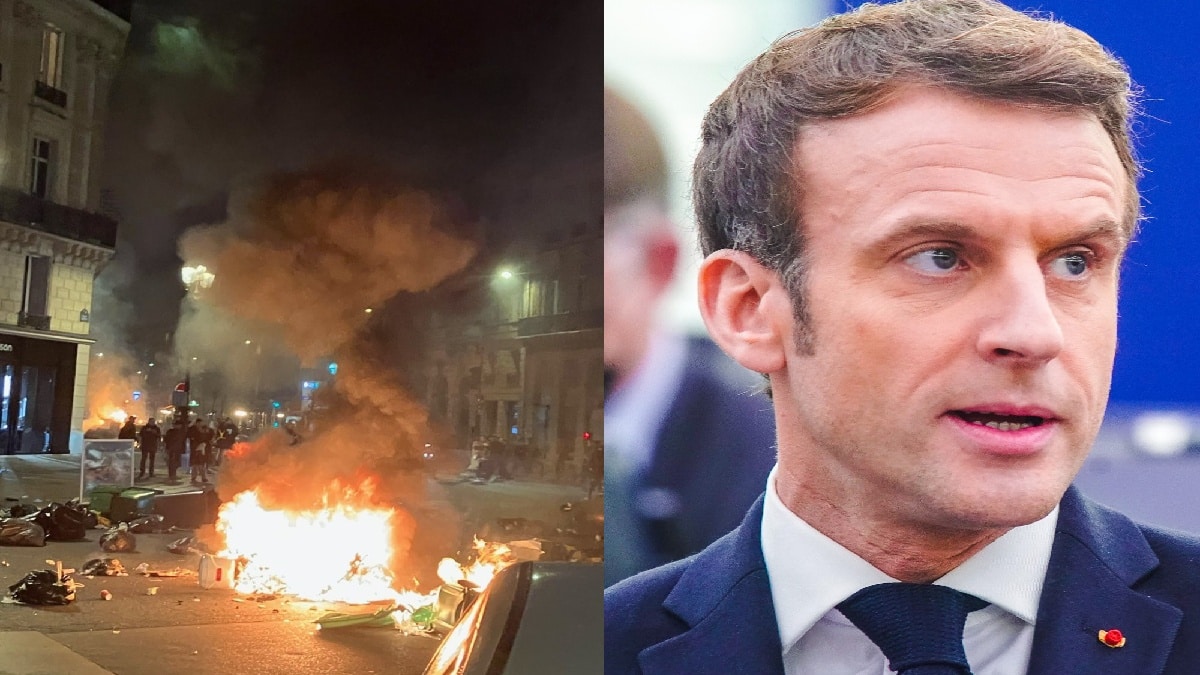
On June 27, 2023, in Paris, 17-year-old Nahel, a French-Algerian resident, was shot dead by a police officer when he tried to escape arrest. Since then, riots have spread across the country, with young people far beyond Paris taking to the streets to protest the shooting. From cars being set on fire to buildings being damaged and vandalized, thousands have lashed out against alleged racial profiling. According to the French ministry of the interior, the 2023 riots have already caused more damage and mobilized more security forces than the 2005 riots—which were sparked by an eerily similar incident.
Days later, French President Emmanuel Macron made an observation about the spreading unrest in his country at a press conference. He said that young rioters had been using social media, such as Snapchat and TikTok, as platforms to organize and orchestrate protests. He also said the rioters were “acting out the video games that have poisoned their minds” and the protests themselves were “a mimicking of violence, which for the youngest leads to a kind of disconnect from reality.”
Games like Grand Theft Auto, Fortnite and CounterStrike, have had their share of blame. They are accused of glorifying prostitution, drugs, murder, carjacking, guns and weaponry. But studies have repeatedly shown that the link between these role-playing games, their storylines and the real-life behaviour exhibited by players is tenuous at best.
In 2018, a study published by the nature journal Molecular Psychology found no difference in the levels of aggression exhibited by 77 volunteers who’d been divided into three groups, two of which were assigned to play GTA V and Sims 3 daily for 30 minutes. Nor did the researchers spot any significant difference in the volunteers levels of empathy, impulse control, levels of anxiety or depression.
A different study published by the American Psychological Association in 2019 concluded that people are more likely to blame violent video games as a cause of school shootings by white perpetrators than by African-American ones. Through an analysis of more than 2,00,000 news articles about 204 mass shootings over a 40-year period, researchers found that video games were eight times more likely to be mentioned when the shooting occurred at a school and the perpetrator was a white male.
A research by the US National Institute of Justice-funded Violence Project found that 26 of the 136 mass shooters in the US since 1992 had played violent video games. Further, 22 of those 26 had at least one mental-health illness or demonstrated psychiatric disorder, even when not diagnosed.
The idea that video games create violent behaviour originated in 1976, after the release of the arcade video game Death Race, in which players would sit behind the wheel and drive over humanoid figures to win. Macron is another politician claiming the corruptive effects of video games, while ignoring much more endemic issues such as social and racial inequality.
Christopher Ferguson, a professor at Stetson University Florida remarked that if video games were the cause of rampant violence, then countries like Japan, South Korea and the Netherlands, which consume more violent video games per capita, would be the primary sites of bloodshed and chaos. But they are actually the three most peaceful countries on the planet in terms of violent crime. He further added that ” To blame video games is a way for elected leaders to get people talking about the wrong thing. Because when we’re busy blaming a role-playing simulation for the ills of society, we probably won’t be asking governments and elected representatives about their failed policies.”
