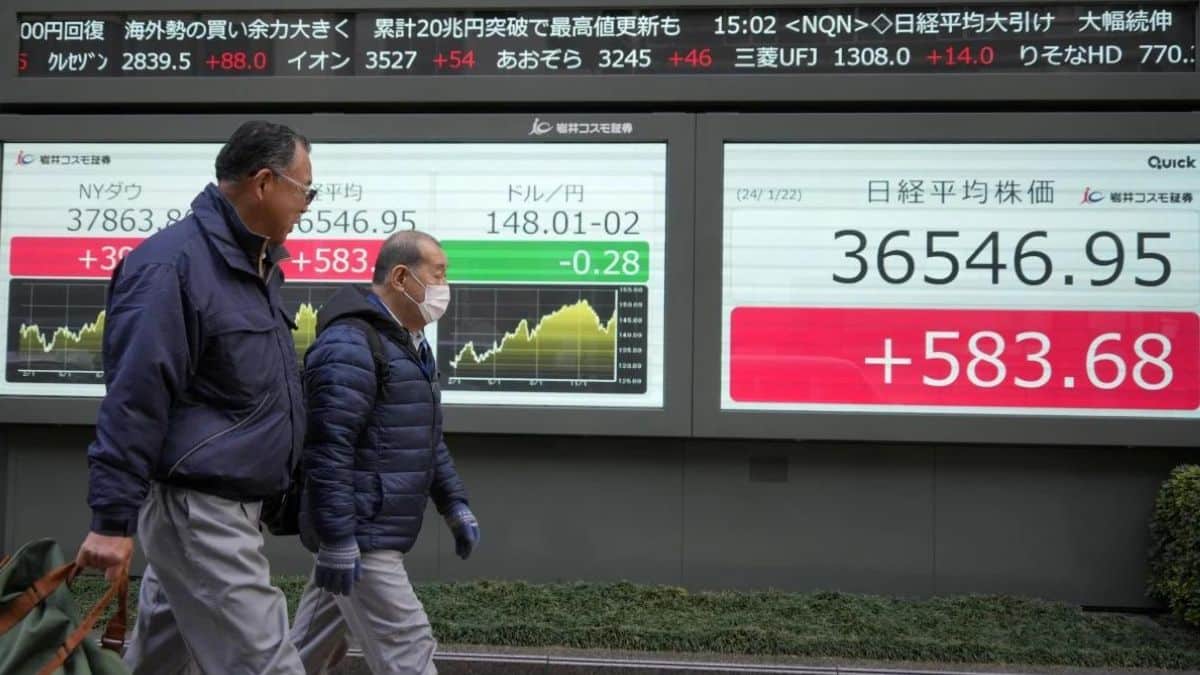
Asian markets : Japan Stock Indices See Mixed Performance, Japan 225 Drops 0.33%
Japan's major stock indices showed mixed responses today, with the Japan 225 Index declining by 0.33%, while the TOPIX Index remained flat at 2,741.29 JPY.

Stay updated with the latest news and articles about Japan stock market.
Japan's major stock indices showed mixed responses today, with the Japan 225 Index declining by 0.33%, while the TOPIX Index remained flat at 2,741.29 JPY.

Kimuratan Corp surged by 42.86% among Japan’s most volatile stocks, while Sunwels Co. dropped 21.92%, showcasing a range of movements across sectors.
Japan’s highest-volume stocks saw Toyota Motor Corp up by 3.37% and Mitsubishi UFJ Financial Group rising 3.26%, reflecting strong investor sentiment in finance and automotive sectors.
The TSE has placed Tokyo Koki under supervision because it may potentially meet the delisting criteria. The specific clause that has triggered this supervision involves situations where a controlling shareholder could take actions leading to significant changes in the company’s share structure.
The Nikkei Stock Average and the Tokyo Stock Price Index (TOPIX) both recorded their largest declines since August 5, a day marked by significant global market volatility. This latest selloff was precipitated by the Institute for Supply Management’s (ISM) report on August’s manufacturing activity, which revealed a contraction for the fifth consecutive month, falling short of market expectations. Particularly hard-hit were technology stocks in the U.S., including Nvidia, which saw its shares plummet, erasing $278.9 billion in market value—an unprecedented drop for a single U.S. stock.
Nvidia’s earnings report, released early on August 29 Japan time, revealed a forecast for the third quarter (August-October) that fell short of market expectations. This miss triggered a steep decline of over 8% in Nvidia’s shares during after-hours trading on U.S. markets. The company's forecast, coupled with issues related to new chip developments, initially spurred a sell-off in Japanese semiconductor stocks. However, the impact was mitigated by Nvidia’s stronger-than-anticipated second-quarter results, which helped to stabilize Japanese stocks related to the semiconductor sector. Additionally, gains in insurance and shipping stocks provided further support to the market.
During the trading session, the Nikkei surged by over 2% before settling at its final figure. The broader Topix index also experienced gains, rising 1.1% to end the day at 2,670.54. The upward movement in the Nikkei was driven by domestic tech stocks tracking their U.S. counterparts higher, contributing to the overall positive performance of the benchmark index.
The dramatic rally in Japan’s stock market came as semiconductor stocks, a key sector in the global tech landscape, experienced significant buying interest. This surge was catalyzed by strong performance in U.S. chip stocks, which had risen the previous day while the Tokyo market was closed for a national holiday.
The dramatic downturn followed the release of disappointing U.S. jobs data for July, which revealed nonfarm payrolls significantly below market expectations and an increase in the unemployment rate. The weak data triggered concerns about a potential hard landing for the U.S. economy, spurring a global sell-off in equities. On Friday, the Dow Jones Industrial Average had already experienced its largest decline of the year, closing down 610 points.
Showing 10 of 11 articles